Thursday, May 17, 2012

France Adventure - May 16, 2012

Bonjour à tous et bienvenue!  Hello, everyone, and welcome to Cépage et Cuisine, Mary's and Brian's wine and food blog.  We're back in France for our next wine, food, and cultural adventure!  Our home away from home this time is Magny-les-Villers, a tiny village in Burgundy.  A year ago, we lived in a nearby village, Villers-la-Faye.  Used in the name of a French village, the term les means "near."  So, Magny-les-Vellers means Magny "near" Villers-la-Faye.  The two villages are separated by less than a kilometer, about a half-mile.
The day began with a trip to the boulangerie for a pastry or fresh-baked bread.  Mary loves the croissant and I love visiting the shop.  You may recall our description of Madame, the very nice lady who runs the boulangerie, speaks no English whatsoever, and talks and talks as if I know everything she is saying.  Her place is sort of a community gathering spot where the people of the village stop by for fresh bread, a daily ritual, and to greet each other and share news.  Mary enjoyed the croissant with pink grapefruit juice, or pamplemousse rosé (who knew?).

Today was our first day back in France after the long journey from Jackson to Atlanta, then Atlanta to Paris, arriving around 8:00 a.m. Paris time, finding our way to the Air France bus to the Gare de Lyon train station for a noon train to Dijon, picking up a rental car in Dijon, and finally arriving in Magny-les-Villers around 4:00 p.m.  Because of the time difference, we departed Jackson on Monday and arrived in France on Tuesday.  Whew! 

Venturing out to lunch in Nuits-Saint-Georges, we selected a brasserie et bar à vin, the equivalent of a pub, a basic lunch spot.  Mary selected a sandwich au fromage d'emmenthal, a simple sandwich of Swiss cheese on a baguette, and I had omelette de jambon et de fromage avec salade, a ham and cheese omelet with salad.  Mary enjoyed a glass of crémant, a sparkling white wine, and I had a small Cotes de Nuits rouge, a basic Pinot Noir of the region.  The server was Jean-Jacques, a friendly young man who is trained as a pastry chef and has worked in Philadelphia and Orlando in the U.S., Berlin in Germany, as well as Burgundy.

Having no appointments, we struck out through the countryside in the hills beyond the Cote. I'm always impressed by the beauty of the Burgundy countryside, how villages are tucked into the hills, and how the dominant feature of every small village is the old church, l'église.
Once again, the iris are blooming all over.  This must be the perfect place for iris.  This picture is in Concœur, a village near Nuits-Saint-Georges. 

Here you can see the village mailbox and an old community water pump.
This village, almost literally a stone's throw from Concœur, is Corboin.  It is a separate small community, so small it would practically be considered a neighborhood in most of the the U.S., a collection of a few homes and gardens, set against a hillside.

Winding our way back down to the Cote d'Or, we found ourselves in the Grands Cru vineyards of Vosne-Romanée, among the most famous vineyards in the world for Pinot Noir, producing wines of rarity and stratospheric prices.  This vineyard, La Romanée Conti, owned in its entirety (monopole) by Domaine de la Romanée Conti, is farmed using only traditional and non-mechanized methods.  Here you see a horse-drawn plow being used between the vineyard rows.  To give you a sense of how prestigious this vineyard is in the world of wine, a single bottle of DRC Romanée Conti retails for $15,750 at a rare wine shop in Chicago.  Not exactly a wine for Tuesday night leftover meatloaf!

This cross in front of La Romanée Conti was placed in 1723 and is an iconic image of the vineyard and Burgundy generally.  Here are a few more images from Vosne-Romanée.


These next few images are from Gilly-les-Citeaux, a village across N74 opposite the Cote.  The architectural style is the same.  Note the small creek and blooming fields of canola.


On the way back to Magny, I decided to visit a vineyard that has produced wines we have enjoyed during tasting events at home, Latricières-Chambertin, on the border between the villages Gevrey-Chambertin and Morey-Saint-Denis.

This view shows a corner of Latricières-Chambertin in the foreground, keeping in mind this is in the commune of Gevrey-Chambertin.  In the background you can see part of Clos de la Roche, a different Grand Cru vineyard in the neighboring commune of Morey-Saint-Denis.  Separated by a lane and basically a row of shrubs and trees, the two vineyards produce wines that are discernibly different even though they are both planted to Pinot Noir.  It is a perfect illustration of the concept of terroir, the French term that means roughly, "the taste of the place."  Differences in soil, slope, aspect, and other natural influences combine to affect the expression of the fruit and the wine.  Below is another photo of Latricières-Chambertin with Clos de la Roche beyond. 


I wrote in a blog post a year ago that a lesson learned about wine is it really helps to go there, wherever "there" is in your wine journey. Seeing vineyards like this while standing in them after drinking the wine that comes from them makes a very complex subject like terroir a little easier to understand.

We found ourselves behind one of the vineyard tractors on the way back to our house.  It illustrates a little about farming in Burgundy.  The vines are quite short, as you can see in the images above of Latricières-Chambertin and in contrast to typical California vineyards.  Tractors are high enough that they can pass over the vines and drop arms down laterally for spraying.
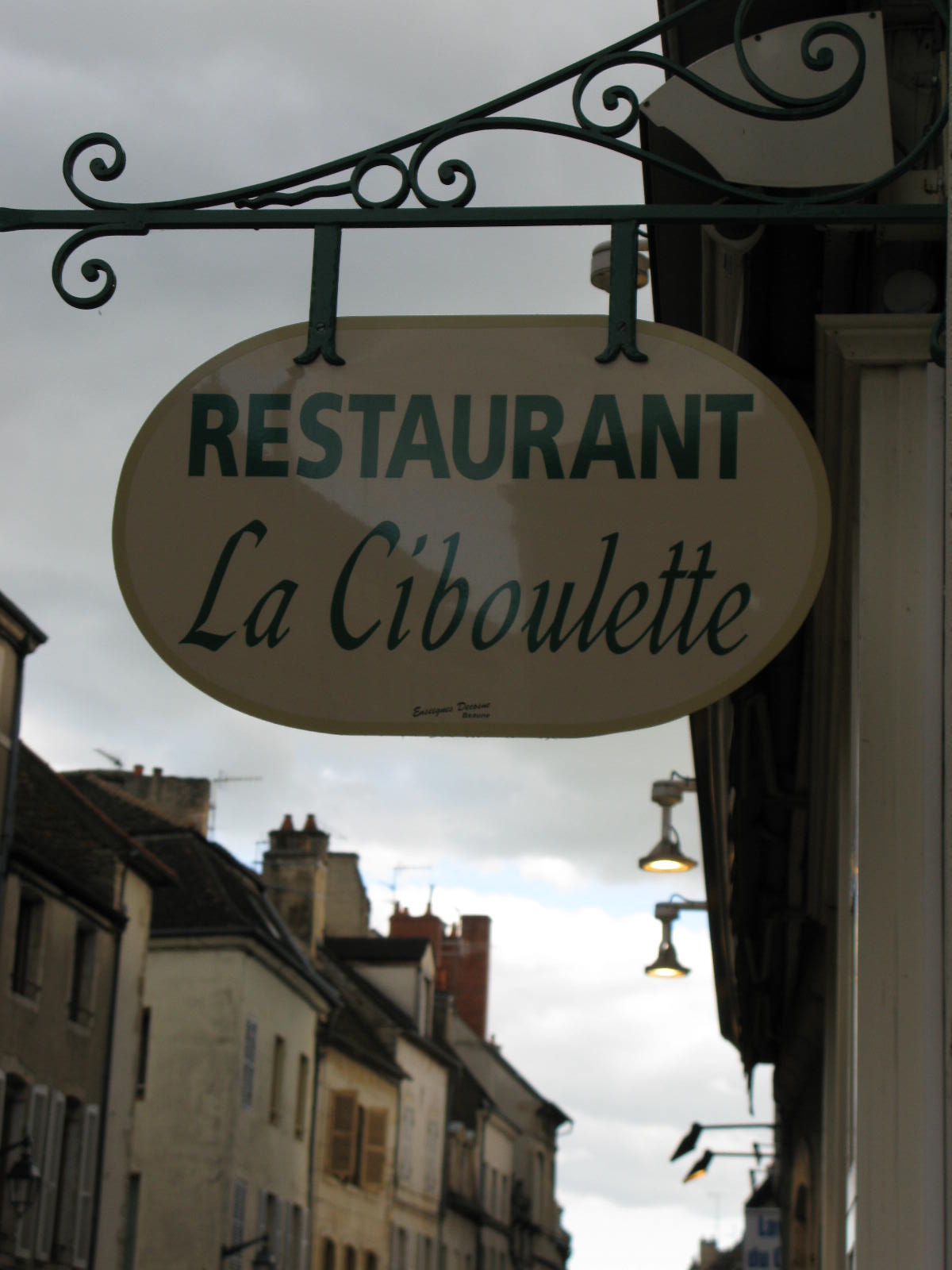
We ended our day with dinner at La Ciboulette, a restaurant in Beaune we enjoyed a year ago.  It is just inside the gate of the old city of Beaune, a small, but well known establishment.

We began the evening with an aperitif of Bourgogne Crémant blanc, a white Burgundy sparkling wine, made from Chardonnay.  I don't know the producer, but it was fresh, crisp, and had nice citrus and yeast notes.  As you may know from many prior blog posts, Mary adores sparkling wine.

The amuse bouche was a little tray of salmon spread on baguette crisps, crunchy radishes, and Niçoise olives.

In France, the appetizer course is called the "entree," unlike in the U.S. The main course is called the "plat." The appetizer course for Mary was a delightful salad of greens, carrots, tomato, and fromage avec lardons, creamy warm cheese wrapped in bacon.

My entree course is less appetizing in the photo than Mary's salad, but it was absolutely delicious. Ouefs en meurette is a dish of poached eggs, mushrooms, and herbs in a red wine reduction sauce.  It is really one of my very favorite traditional Burgundian dishes.  The blend of flavors is sensational and the egg yolk oozing into the sauce is amazing.

And now for the main course.  Mary selected rôti de magret de canard, roast duck breast.  Duck breast has become one of our favorite dishes, even at home.  Mary said this one was delicious, served in au jus.

My main course was a new experience for me, rôti de joue de porc, pork cheeks, slow cooked all day.  They were tender, moist, succulent, flavorful, like a wonderful pork roast, served in a red wine sauce.  Both of our dishes had spring peas, greens, and squash.  Even the vegetables were delicious.  A scalloped potato portion completed the dish.  It was so good we both saved the last bit of it for our last bite of the main course, creamy and cheesy on the inside with a delicious crust on the outside.


Mary's dessert course was assiette de chocolat, assorted chocolates.  Mousse, ganache, a pudding sauce, and sort of a brownie made up the cast of characters.
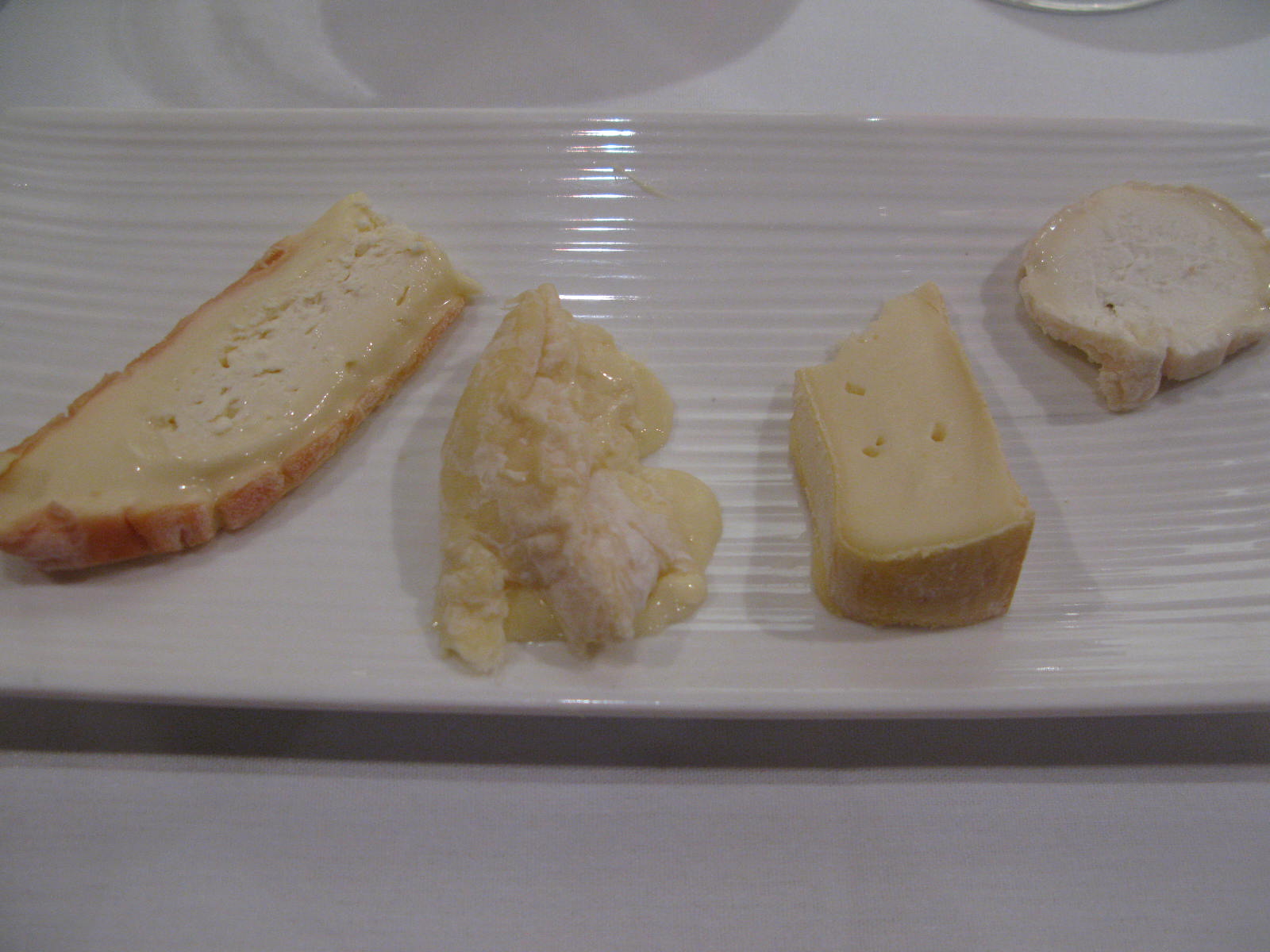
I had an assiette du fromage, assorted cheeses.  One of my favorites, Epoisses, was there, along with a nice Chèvre, and a Reblochon, a cheese which cannot even be obtained legally in the U.S. because it is unpasteurized when shipped.  We have come to really appreciate a nice cheese course as an end to a nice dinner.


Here's a big part of the reason for our adventure, our passion for the wines of France, especially Burgundy.  Madame Isabelle at La Ciboulette understands her cuisine and the wines on her list and how to pair them.  A year ago when we ordered lamb and beef, her recommendations were very different.  This year, she recommended a wine of more delicacy, finesse, and elegance.

We selected a Domaine La Pousse d'Or Volnay En Caillerets 2007 to pair with the duck and the pork and, let me say, it did not disappoint.

You can see here the wine is classifed as a Premier Cru, designated on the label as "1er Cru."  This is the second highest quality designation for the wines of Burgundy.  Only Grand Cru is more highly regarded.


The aromatics were wonderful with notes of red fruit, floral characteristics, and earth.  The palate was silky smooth with good acidity, which made it pair well with food, and flavors of red cherry, spice notes, and a mineral quality.  The best quality of this wine was its balance and harmony of flavor, acidity, tannins, and alcohol, all elements relating to the others in proportion.  I would describe it as exquisitely balanced, moderate in complexity, with nice length.  It was only 13.0% alcohol.  All in all...sublime.  We hated to see the bottle, and the evening, come to an end.


Finally, and naturally, we enjoyed coffee.  It just seems like one more sensory experience that finishes a wonderful dinner.

Madame Isabelle....merci beaucoup.  Until we meet again.  And thanks, too, to our new friends at the next table, a delightful bilingual Canadian couple from Montreal who graciously assisted us with interpretation.

That's our post for today.  Stay tuned for more posts during our France adventure.  We will be in Burgundy for a little more than a week, then transfer to Alsace.  In the meantime, keep checking back at Cépage et Cuisine. 

Cheers!


Brian♥Mary


P.S. Our Internet connection in Magny-les-Villers is slow and intermittent.  I had to work on this post off and on throughout the day.  If a day or so passes without a post, keep checking back.  We will write when we can.


Monday, January 16, 2012

Caribbean Cuisine - Tropical Memories

Hello, everybody, and welcome back to Cépage et Cuisine, Mary’s and Brian’s wine and food blog.  I’ve been busier than a one-armed paper hanger with work and travel, so it has been a while seen we’ve posted.  We’re back, though, with more stories about wine and food.

This post is about our recent trip to St. John in the U.S. Virgin Islands and a lovely dining experience.  I was there on business (really, no kidding!) and Mary came with me to enjoy the beauty of the location.  It certainly lives up to its reputation for beauty, as you can see in these photos.  Most of St. John is a national park, so wildlife is abundant.  Deer are numerous and nearly tame, not at all spooked by proximity to humans.

There is also a large population of donkeys, like these, just outside our door, apparently descended from old sugar cane plantation animals.
St. John is one of three main islands that comprise the U.S. Virgin Islands. The largest and most populous is St. Thomas, which is where the airport is located.


Transfer to St. John is via water taxi, which happened to have the name Mary II, a ferry ride of about a half-hour with rum punch offered to help enjoy the journey.  The third island, quite a distance to the south, is St. Croix.  The British Virgin Islands are just beyond St. John, close enough that AT&T cautioned us about picking up cell phone signals from them.


In its long-ago history, vast sugar cane plantations were located in the islands.  Most of the people of the USVI are descendants of Africans who were transported there and enslaved to work the sugar cane.  The language reflects the combined influences of the French, Spanish, Americans, British, Dutch, Danish, and Africans.  The result is a rich and delightful mélange of Creole island language.  The Caneel Bay Resort property includes the ruins of a 17th century sugar mill.  Mary walked among the ruins and took these terrific photos.


The Sugar Mill Restaurant is adjacent to the sugar mill ruins, an open air restaurant that specializes in Caribbean cuisine.  Our table had a view of Caneel Bay and the lights of St. Thomas across the water, caressed by a gentle tropical breeze, just beautiful.  Our server, Lincoln, was completely knowledgeable about the menu.


The first course was “conch two ways,” conch cakes and conch ceviché with a corn and black bean salsa.  We rarely have the opportunity to enjoy conch, a sea snail of the tropics, but it is common in the islands and south Florida.  The two preparations were delicious.  The conch cakes had an exterior crispness, an interior moistness, and a delightful spiciness.  The ceviché was tart and refreshing with crunchy vegetables to complement the conch.  We loved this dish.

Mary selected seared scallops, one of her favorites.  This version included scallops on a bed of yuzu fruit, sweet potato, and butter.  Yuzu is a citrus that is sort of a cross between grapefruit and tangerine.  The fruit and the potato provided a sweetness and creaminess that complemented the scallops.  The garnish of microgreens was amazing, a combination of arugula, tarragon, and pancetta.  Mary raved about that little salad.  The sauce was a spicy barbecue.

I selected pan-seared red snapper on a bed of saffron rice and seafood bouillabaisse of shrimp and scallops, topped with the same delightful microgreens salad.  I’d love to learn to prepare fish this way, crisp skin and cooked through while maintaining delicate moistness and flavor inside.  The executive chef, Chef Michael, paid a courtesy call to our table to discuss the cuisine, the flavors, the preparation.  We always love personal attention like that.

The wine list was surprisingly good for what I thought was a somewhat remote tropical location.  With the warm temperature and the Caribbean cuisine, we wanted a cool and refreshing white wine.  With the assistance of a completely knowledgeable sommelier, we selected a Sauvignon Blanc from New Zealand, produced by Kim Crawford.  It was the perfect choice, clean and refreshing with an interesting peppery note, seamless with the dinner.  Here are my notes on the wine.

Kim Crawford Wines Sauvignon Blanc Marlborough 2010.  Like most New Zealand Sauvignon Blanc, this wine sees little or no oak so the fruit shines through, highlighting intense grapefruit and mineral aromas.  The palate vibrates with mouthwatering acidity and citrus, melon, and herbal flavors, most notably jalapeño pepper.  It did what a good wine of this type should do, accent the food and refresh the palate for the next bite.  It was well balanced, moderately complex, with short to medium length.  The restaurant price was $48.  By coincidence, we had dinner a few days later back in Jackson and saw the same wine on the list for $24.

Mary had a delightful dessert of pineapple cake, vanilla ice cream with caramel topping, and fresh berries.

The evening was delicious in more ways than just the food and the wine.  The weather, the ambience, the location, and a wonderful evening with my wife all add up to a memorable experience.  That’s our post for today.  We hope you found it interesting.  Keep checking back for more wine and food articles at Cépage et Cuisine.  In the meantime,

Cheers!

Brian♥Mary

Sunday, December 18, 2011

Lemon Caper Beurre Blanc – Sauce Divine!

Hello, everybody, and welcome back to Cépage et Cuisine, Mary’s and Brian’s wine and food blog.  Work and travel have kept us from blogging over the past few weeks, but we’re back with more wine and food adventures.  Today, we’re describing a dish we prepared recently with an emphasis on the sauce, lemon caper beurre blanc.

I love a great sauce on fish and poultry.  It makes a simple dish much more exciting and creates lots of delicious wine pairing opportunities.  Beurre blanc is versatile and works well on almost any fish (ok, I probably wouldn’t use it on fried catfish).  I’ve watched Mary make it several times and there is a bit of a ballet involved.  Things need to be added in the correct order, at the right time. She is always careful to make sure the butter is cold and hard, and she uses heat some of the time and takes it off the heat some of the time.  It finishes rich and tangy, just as the food is plated, added to the dish just before serving.  I love it! 

Beurre blanc is an example of an emulsion of oil in water.  An emulsion is a suspension of two liquids that don’t normally mix by adding droplets of one liquid to the other, such as oil and vinegar or mayonnaise.  The aqueous or water-based part must be acidic.  You can use vinegar or an acidic white wine, which would be most white table wines.  I don’t recommend the cooking wine that is available at the grocery store.  It is poor quality and has added salt.  When cooking with wine, follow the rule of not cooking with a wine you wouldn’t drink.  The other acidic liquid you can use is citrus juice, which is what Mary uses.  She doesn’t like to open a bottle of wine just for a little for cooking, but it’s fine if you do.  You can use some of the rest to sip while you’re working on dinner.  Now, that’s cooking with wine!  Here’s Mary to talk through the beurre blanc preparation.

I use a very simple recipe.  It is just lemons, butter, dried Provençal herbs, and capers.  Many recipes call for shallots, which would be fine.


I melt the butter in a stainless steel saucepan, although an enamel-coated sauce pan is recommended by Julia. 


After the butter is melted, I add a little of the lemon juice (or white wine) at a time while stirring it into the butter.  In Brian’s chemistry lesson (sheesh!), he said add it in droplets, but I just do it in small amounts, not exactly droplets.  This is the time to add the capers.  You can mash a few of the capers to release more flavors.  Then I let that mixture reduce by about a third to get it to a better consistency.  I add a little salt and pepper. 


Now it’s time to add the rest of the butter.  This is when it is important to turn off the heat and for the butter to be nice and cold.  The butter is melted gradually and stirred to make a rich and buttery sauce.  I want a consistency that is nice and spoonable, not too thin, but not a paste.  It is a recipe that takes a little practice.  Once you do it a couple of times, it’s pretty easy and turns out nicely.


We love to cook on an outdoor grill.  We use our grill at least a couple times a week, year around.  When we cook firm fish, which is often, we almost always grill it.  It’s easy, fast, delicious, and frees the kitchen for other uses.  This dinner is grilled swordfish, which is readily available in the supermarket, seasoned with herbs and spices and a little olive oil, grilled simply on medium high heat for about 6 minutes on each side.

The side dishes were roasted root vegetables and wilted spinach with garlic.  This is the perfect time of year for root vegetables.  They are plentiful, diverse, colorful, and nutritious.  Winter squashes, turnips, parsnips, carrots, and sweet potatoes make an otherwise ordinary dinner more interesting with no more effort than it takes to dice the vegetables and put them in the oven.
  

For just the two of us, we choose only a couple of vegetables so we don’t have a lot left over.  For this dinner I chose beets and rutabaga.  Peel ‘em, dice ‘em, season with salt, pepper, whatever herbs you like, drizzle with olive oil, toss and bake for about 45 minutes.  That’s it!  And they are wonderful!  Brian especially loves the roasted beets. 

Here are the vegetables, right from the oven.  Now, here's Brian to talk about the wine.


When I first envisioned this blog post, I thought it would be about Chablis, but I think I’ll save that detailed explanation for another entry.  Briefly, though, Chablis is considered part of Burgundy, northwest of Dijon and cooler than the rest of Burgundy.  As the name implies, the center of the appellation is the village of Chablis.  The grape of Chablis is Chardonnay.  The soil of Chablis is chalky limestone with disintegrated fossilized seashells, known as the Kimmeridgian ridge, from when the area was under the ocean.  When walking around the village, you notice the streets and sidewalks have a white, chalky, powdery dusting everywhere. 
The cool climate and the soil create a wine with lively acidity, citrus fruit, apple, and mineral aromas and flavors, often described as flinty, with wonderful characteristics of crushed oyster shells, like wet stone.  Little new oak is used in the vinification and élevage, sometimes just stainless steel tanks, allowing the grape aromas and flavors to shine through.  Chablis is wonderful for light fish dishes, especially shellfish.  The saline tanginess of Mary’s beurre blanc is the perfect pairing.

One of our favorite Burgundy producers is Domaine William Fevre in Chablis.  Fevre has some of the choicest holdings of vineyard parcels in the appellation, ranging from the Chablis village appellation wine through various Premier Cru vineyards, and the seven Grands Cru sites, at price points from less than $20 to more than $100 for the Grand Cru wines.

For this dish, I chose the Fevre Chablis 2005.  This is the village level Chablis, not a Premier or Grand Cru.  The grapes come from several vineyard sites, but all of them have the famous Kimmeridgian clay soil.  It provides an excellent example of the appellation without reference to unique characteristics of a specific vineyard site.  If you want to learn what Chablis tastes like, a village-level Chablis from a good producer is the way to start.  It is a good value, inexpensive enough that you can enjoy it often, and pairs well with many foods.  Here are my notes on the wine.

Domaine William Fevre Chablis 2005.  This is a terrific wine at an excellent value, only $15.  It has all the characteristics of Chablis.  The aroma is lemon, tart, green apple, and minerality.  The palate has that great wet stone freshness, bright lemon, great acidity, a delicious chalky, oyster shell quality, and an interesting honeyed note.  It is refreshing and delicious with the right food.  The balance is perfect with moderate complexity and good length.  The alcohol is a lean 12.5%.  Mary “hearts” this wine.

We finished dinner with a slice of Époisses and pecans.  Époisses is a strong smelling, but mildly flavored cheese produced in the village of Époisses, not far from Chablis.  Like many French products, it is known by the place it is produced, reflecting the French belief, refined over thousands of years, that the specific characteristics of a place produce an expression that is different from other places.  Following a good rule that what grows together, goes together, Époisses is an excellent cheese choice to pair with Chablis or other wines of Burgundy.  To be honest, though, we love it with many different wines.  It is definitely one of our favorites. 

Here’s the finished dinner again, ready to enjoy on a Wednesday evening, just a regular weeknight dinner with simple ingredients, freshly prepared, with a little attention to pairings and timing.  It was not an elaborate, expensive, extremely time-consuming dinner, but it was a wonderful way to share each other’s company after another busy day.  Life is pretty darn good.

That’s our post for today.  We hope you enjoyed it.  Keep coming back to Cépage et Cuisine for more wine and food experiences.  Also, check out our nightly Tweets at http://www.twitter.com/cepageetcusine.  Until then,

Cheers!

Mary♥Brian