Thursday, May 19, 2011

May 15, 2011 France Adventure

Bonjour, everyone!  Welcome to Cépage et Cuisine, Mary’s and Brian’s wine and food blog.  We are on a wine, food, and cultural vacation in France.  We’re posting notes and photos about our daily experiences, beginning with May 8, 2011.  If you haven’t read the blog in a while and you would like to see the earlier posts, scroll down below this one, as well as click on dates of earlier posts on the right hand side of the blog.
Saturday, May 14 was a travel day.  We transferred from Villers-la-Faye in Burgundy to Le Puy Notre Dame in the Loire Valley, our new home away from home for the week.  It is an easy day’s drive, about 6 hours.  Sunday is a quiet day in France.  The day started with a walk to the boulangerie, just a minute or two from us, for pain chocolat, a bread roll with chocolate.
We got eggs at the grocery on Saturday for breakfast on Sunday.  The groceries here have giant stacks of trays of brown eggs and you select the eggs you want individually.
Most wineries and other businesses are closed on Sunday, so we went to church, sort of. Le Puy is translated to “the hill.”  It is literally a village on a hill, surrounded by vast plains of vineyards and gardens.  It is much larger than Villers-la-Faye, but still a small town.  The overwhelming architectural feature of the village is Collegiale Notre Dame.  It is massive, ornate, and can be seen for miles.  Mary did a bit of online research about it and learned that some of the building dates to the 5th century, but most of it dates to the 12th to 13th centuries.  Services are held on a circuit basis every few weeks, alternating with churches in other villages.  Here are photos we took on a self-guided walking tour of the village.
As we entered the church, words like magnificent, amazing, and awesome come to mind.  “Awesome” is a term that has been cheapened by contemporary use, in my view.  My adult children say Mary’s meatloaf is awesome.  I think people of my generation and older reserve the use of the term for more serious descriptions, which is what we’re describing here.  Mary grew up Catholic and attended Catholic schools, so she is more familiar with Catholic churches than I.  Here are some of her comments.
This church truly is awesome.  When we entered the church, there was a button for lights and music. We were the only ones there, so we pushed the button, and the music was beautiful.  We walked up to the altar past very plain chairs and unbelievably uncomfortable kneelers.  There was one lone confessional near the back that brought back memories of Saint Gabriel in San Francisco and all those confessions (especially during Lent). The church has quite a few statues of Mary, which I, of course, found very interesting.
These memorial markers in the church list the members of the community or the church who died in World War I.  Every village has these and they all have a long list of names.  World War I was absolutely a slaughter, so many boys from a small town.  These are the names only for 1914 and 1915.  There is another marker next to this one that lists the names for 1916 – 1918.
The architecture of this area of France includes many structures built of a light colored limestone called tuffeau.  Magnificent castles, chateaus, and everyday homes are built of the stone.  Here’s a typical example of a building in Le Puy Notre Dame constructed of tuffeau.
We’re staying in a rural gite, a guest house.  It is within a cluster of buildings that previously included a chai, a winery.  Much of the building materials is of the same tuffeau stone.  Our hosts, Sheila and Brian Barcroft, a very nice English couple, live on the property at Le Clos des Guyons and invited us for aperitifs before dinner to relax and get to know each other.  They are very knowledgeable about local wine and shared a wonderful example of a Saumur Crémant, a type of sparkling wine.  I was surprised to learn that about half the total production of the Saumur appellation is sparkling, not as well known around the world as Champagne, but highly regarded and much less expensive.  Here are a few photos of the gite.
We shopped Saturday on the way to Le Puy Notre Dame to cook dinner Sunday.  Mary prepared a simple baked salmon with parsley potatoes.  We picked up fresh spring peas in the pod, which were delicious and reminded me of experiences earlier in life when I sat with my mother, grandmother, and sisters while we talked and shelled peas.  It was tedious back then, but a nice memory.
Dessert was a little Epoisses and a chocolate éclair for Mary we bought at the boulangerie while we were walking around the village.
Coincidentally, we brought the Domaine Simonnet-Febve Crémant rosé with us from Burgundy and opened it with dinner.  It was cool, refreshing, with a nice creaminess, baked bread, and fruit character.  It was a very nice pairing with dinner.  Here are my notes on the wine.
Domaine Simonnet-Febvre Crémant de Bourgogne Brut Rosé NV.  This is the first time I have had a Crémant of Pinot Noir, not to mention a rosé.  Like many rosé wines, it had nice aromas of melon and strawberry.  Like many sparkling wines, it had lovely yeast or baked bread on the nose.  The palate was refreshing, bubbly, had bright acidity, and the same berry flavors.  Nicely balanced, not highly complex, not long on the finish, but a pleasurable experience and paired well with dinner.  12.0% alcohol.  We paid only €8 for this enjoyable wine.
That’s our post for today.  Keep checking back at Cépage et Cuisine for more wine and food adventures in France as we transition to the Loire Valley.  In the meantime,
Cheers!
Mary♥Brian

Wednesday, May 18, 2011

May 13, 2011 France Adventure

Bonjour a tous!  Hello, all, and welcome again to Cépage et Cuisine, Mary’s and Brian’s wine and food blog.  This is our Friday the 13th report from France (Happy 3rd birthday, Catherine, from Gram & GrandDad), our last day in Burgundy before our transfer to the Loire Valley for the next part of our trip.  You’ve read about our daily walks to the boulangerie for pastries or croissants and the very delightful lady who runs the shop.  Well, here she is.  We never learned her name.  Her English is even more limited than our French, which is to say she doesn’t speak a word of English, not a word.  We just call her Madame.  She is always friendly, just jabbering away in French as if we know what she is saying.  We’ve taken to writing things down in French, based on Google Translate, which she appreciates, then she corrects our grammar and shows us the corrections the next day.  We were sad to say goodbye.  She wished us well…I think.  Goodbye, Madame.  See you next time.  Au revoir.
We had no appointments for today and so we decided to head south of Beaune for a look at the villages in the Côte de Beaune and especially some of the famous vineyards there.  We stopped in Pommard for lunch, which turned out to be one of the memorable dining experiences of our trip so far.   Auprès du Clocher is a new restaurant in Pommard, adjacent to l’eglise, the church, so we loved hearing the bells ringing.  Auprés du Clocher translates roughly to “with the bell.”   The chef is well known in Burgundy.  We encountered an American couple from Vermont outside the restaurant perusing the menu with us.  They know the chef from his previous restaurant and were basically following him to his new place.  She is a high school French teacher so she helped us understand the menu, which you see here, so in we went.  This is elegant, white linen, formal, modern, creative French dining.  We arrived about 12:30 and departed about 2:30, not a lunch for busy people trying to grab something quick and then run errands on your lunch break.
First things first, we ordered a half-bottle of vin blanc from the Côte de Beaune, a Domaine Lafouge Auxey-Duresses Les Boutonniers 2007.  Once again, it is classified as a village-level wine and we were thrilled with it for an elegant lunch like this.  It was clean, crisp with refreshing acidity, and tart lemon citrus and fresh minerality.  Many restaurants in Burgundy, and increasingly in the U.S., offer wines by the glass, half-bottle, and bottle.  A half-bottle is 375 milliliters, 12.5 ounces, or about a nice glass or so per person for two people.  Over a period of a long, leisurely lunch of two hours, it is almost completely metabolized by the time lunch is over and you have a cup of coffee.  I wouldn’t do it on a business day, but on a leisure day, it was very enjoyable.
The first dish was these little gougeres, tiny little breads with thinly sliced almonds, which Mary adored.
The first course was a cool spring soup in a cream base with fennel and a red pepper glace…very different.  The next preparation was so good we ate it without taking a photo, but it was a broccoli puree with smoked mackerel.  The Chardonnay was really singing with this course.
The main course was a chicken with zucchini, onions, greens, and the juice of red bell peppers.  Who knew?  It was just fantastic.  The flavors blended seamlessly, the chicken was flaky and tender, the wine accented it perfectly.  I am just continuously amazed at how they know how to pair food ingredients and tell us how this or that wine will interact with the food.  There is a level of knowledge among many restaurant workers that we don’t commonly encounter in our typical restaurant experiences in Jackson, to say the least.
Dessert was a glace de framboise, or raspberry ice and fruit concoction that Mary said was just delicious.  Like Restaurant Simon the previous evening, the chef prepared a fresh fruit course for me.
Confections for Mary and coffee for both of us finished off a memorable lunch by mid-afternoon.  We left happy and, once again, astonished.
The church and the mairie, or town hall, was next door.  We saw children crossing the street and going into the town hall and we concluded it also serves as a primary school.  It looks like an old building and I doubt the classes are now single gender, but the school was apparently segregated by gender in the past.  On one end above the windows you see, garçon, or boys, and on the other, filles, or girls…very interesting.
We also took some photos from the second floor window of Auprès du Clocher, just looking down the street.  I thought these pictures were really interesting as a lesson in Burgundy.  You see the street in Pommard, ending abruptly at a vineyard, which is part of Pommard, but in the distance just on the other side of the vineyard, you see the next village, Volnay.  Pommard and Volnay are both household names to Burgundy enthusiasts, but what many people don’t know are these Burgundy villages are just a stone’s throw apart, often separated by just a field or a vineyard.  Their wines are quite different, however, Pommard being more tannic and rustic, Volnay being more elegant and refined, just a reflection of the difference in terroir.  The difference in distance is not more than a city block or two in our frame of reference.
After leaving Pommard, we went to Meursault and sought out the “cellar door” or tasting room of Domaine Patrick Javillier, the producer of the Pommard we enjoyed so much at La Ciboulette last Sunday.
Mary wanted to mail some postcards, so we went to the post office in Meursault.  A plaque on the wall of the post office commemorates the relationship between France and Thomas Jefferson, who was the American ambassador to France from 1785-1789.  Jefferson traveled extensively in France, including in Burgundy, and became America’s first true wine expert.  He was particularly fond of the white wines from Meursault  It was inspiring to me to see the Burgundians acknowledge the relationship between our two countries this way on the occasion of the bicentennial of their revolution.
Here’s a photo of the Meursault town hall, another good example of typical Burgundian architecture.
After leaving Meursault (which is to say we drove for a couple of minutes), we found ourselves in the rarefied world of the Grand Cru vineyards of Puligny-Montrachet and Chassagne-Montrachet.  In the late 1800s, with their economy struggling, the Burgundians decided to append the names of their most famous vineyards to their village names to stimulate tourism and in hopes of attracting economic support.  Since the famous Chardonnay vineyard, Le Montrachet, was partly in Puligny and partly in the village of Chassagne, Puligny became Puligny-Montrachet and Chassagne became Chassagne-Montrachet.  Well, it worked.  I have never tasted a Montrachet because they are hundreds of dollars per bottle.  Perhaps one day I’ll have the opportunity.  Other villages did the same, such as Morey-Saint Denis, Chambolle-Musigny, and Gevrey-Chambertin.  The last part of their names are actually names of their most prestigious vineyards.  Here are a few photos of us in the promised land of white Burgundy and a few other images we thought were pretty, including Le Montrachet through the gate of the section owned by Bouchard Père et Fils.
We cooked in for dinner, a simple dinner of jambon persille, a terrine of the local ham with a salad and vegetables.  We opened the Bouchard Volnay Les Caillerets and enjoyed it so much.  It had refinement, elegance, finesse, complexity, everything we want in a mature red Burgundy.  Wines like this are a big part of the reason why I want to come over here so much.  Here are my notes on the wine.
Bouchard Père et Fils Volnay Caillerets 2009.  We expected this wine to be memorable and we were not disappointed.  With 11 years to mature, it has reached optimum drinkability, although I'm sure it would last much longer.  The perfume is wonderful, great earthy, forest floor notes with dark cherry, floral aromas, maybe even some leather notes.  The palate shows that great Pinot Noir velvety texture and richness while retaining elegance, finesse, and delicacy.  I think the glory of Pinot Noir is as much about texture as it is about aromas and flavors.  The same earth, dark cherry, maybe currant fruit shows on the flavor profile.  The acidity was medium for excellent balance.  The wine was complex and long finishing, just a terrific wine experience in Burgundy.  13.5% alcohol.  It is a great memory.  We paid €75 for this wine.
That’s our post for today.  We leave Burgundy and Villers-la-Faye tomorrow to move to the Loire Valley for the next part of our wine and food adventure in France.  Keep checking back at Cépage et Cuisine.  In the meantime,
Cheers,
Mary♥Brian

Tuesday, May 17, 2011

May 12, 2001 France Adventure

Bonjour, les amis du vin et cuisine, and welcome again to Cépage et Cuisine, Mary’s and Brian’s wine and food blog.  If you haven’t checked the blog in a while, we’re posting daily reports from our wine and food vacation in France.  Take a look at recent postings.  Since we're posting frequently, use the links on the right side of the blog page to access reports dating back to May 8.  Thursday, May 12 was a day spent close to home.  A morning in France is not complete without a walk to the nearby patisserie and boulangerie.  My dietary restrictions don’t permit me to indulge, but I enjoy the aromas, the culture, and interactions with the people in the shops.  Mary chose the abricot or apricot tart.  Here she is to talk generally about French breads and pastries.
I don’t eat croissants in the U.S. very often.  I think a good, fresh croissant in the U.S. is as good as a fresh croissant in France.  A big difference between France and the U.S. is that where we live we don’t have easy access to a bakery like this.  Some neighborhoods in cities have them, but in France, there is a boulangerie, a bakery, in every little village.  Many people just walk to them.  They’re like a morning gathering place in the community where people see each other and exchange greetings and news.  Many of the shops are also patisseries, or pastry shops.  The French pastries are lighter and not as sugary sweet and syrupy as U.S. pastries and tarts.  The French palate seems to pay more attention to finesse and flavor nuances in contrast to Americans who tend to prefer richer, bolder, sweeter flavors.  Think about the pastries you might see at Starbucks.  French bread appears automatically on the table of any French restaurant, café, and bistrot.  Bread or rolls on the table is not unusual in many American restaurants, of course.  I noticed a slight variation from restaurant to restaurant in the bread in France, which is not surprising because so many different small bakeries make it.  Good bread is good bread, no matter where it is made.  Fresh, daily baked bread is just a more regular part of life in France than in the U.S.
Our first appointment of the day was at Domaine Bouchard Père et Fils.  Bouchard is an old and large Burgundy producer located in the Beaune Chateau or castle.  Here’s the Bouchard maison or family home inside the Chateau and elaborately landscaped grounds.  The family actually owned a vineyard privately, Les Caillerets, in the village of Volnay, as early as 1735.  Private ownership was unusual at that time.  Most of the vineyards were owned by the church or nobility until the French revolution as we discussed in a previous post.  After the revolution and over the years, Bouchard acquired many vineyard sites up and down the length of the Côte d’Or.  We’ve enjoyed their wines many times, red and white, and have found that we can trust the label.  If it’s a Bouchard wine, it’s probably going to be balanced, varietally correct, and pair well with food.
This is one of the few tours that charges a fee.  It was €15 per person, but it was very interesting, lasted almost two hours, walking through the ancient subterranean cellars of the Beaune Chateau, dating to the 11th century, and seeing 150-year-old bottles of wine still stored there and occasionally opened for special occasions.  The tour then concluded with a tasting of four reds and four whites, beginning with Bourgogne and progressing up the ladder to village, Premier Cru, and Grand Cru, illustrating how complexity, finish, and other characteristics vary with vineyard site and classification level.  The monks got it right!  It was very educational.  We bought a bottle of Volnay Caillerets 1999 to have with dinner the next night back at Villers-la-Faye.  If you’d like to learn more about the Burgundy classification of Bourgogne, village wine, Premier Cru, and Grand Cru, take a look at a blog post I wrote back on September 30, 2010.  You can access that by clicking on the archives, year, and month on the right side of the blog.
After the Bouchard tour, we walked down the street in Beaune to a bouchon, a butcher shop, and picked up some charcuterie, a summer sausage, and a small quiche, then to a nearby fromagerie for a bit of cheese.  We went back to the house for an easy lunch.
After lunch we went to the nearby village of Magny-lès-Villers (Magny “near” Villers-la-Faye) for our afternoon appointment at Domaine Naudin-Ferrand.  Magny-lès-Villers is almost literally a stone’s throw from Villers-la-Faye, less than a kilometer, or about a half-mile.  We can see the Magny rooftops from our house in Villers-la-Faye.  Frank Germain, who with his wife, Laura, owns the house where we are staying, was a school classmate of Claire Naudin who now manages the domaine.  Frank and Laura provide a bottle of Claire’s wine for all their guests.  We enjoyed the wine and emailed her to ask if we could visit.  She was planning a big social event for May 14, but agreed to see us.  Her wines are pleasant, light-bodied, fresh, low in alcohol, around 12%, and definitely built for food.  She does her own vineyard work, too, in the Hautes-Côte de Nuits and Hautes-Côtes de Beaune.  She was so busy, we didn’t stay long.
Just up the street from Domaine Naudin-Ferrand, the hillside view gives you a good look at our village, Villers-la-Faye.  You can see Villers-la-Faye is separated from Magny-lès-Villers by just a field, really.  And just off in the distance beyond Villers-la-Faye, you see the next small village.
Dinner was at Restaurant Simon in Flagey-Echézeaux, just a 15-minute drive, basically across N74 from Vougeot.  I found a New York Times review of the restaurant and read some individual reviews online, so we decided to try it.  It was a wonderful experience, elegant, but with a country feel at the same time, wood shutters standing open to the pleasant evening air.
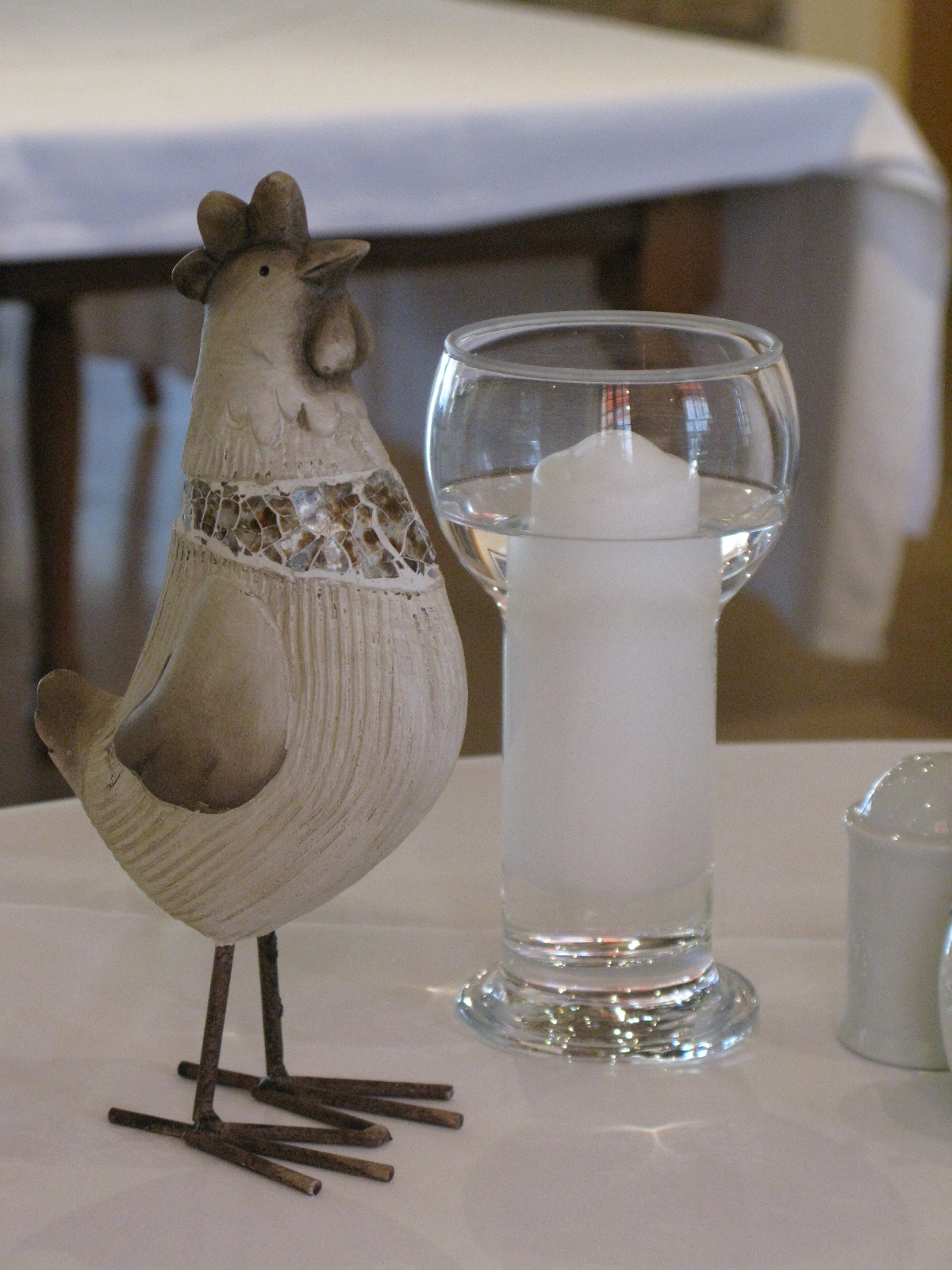
Mary loved the little chicken figurines on all the tables.
The amuse bouche consisted of bites of crème brulée, lemon ice, and shrimp on a puree of fennel and mint.
I had a first course of jambon, a local ham, which is thinly shaved and hugely popular here, with green and white artichokes.  I don’t know what was in the sauce, but I’m including the photo here even though it’s fuzzy.  The dish was unforgettable, a flavor combination and sensation I’ve never had and wish we could duplicate.
The main course for Mary was coq-au-vin, chicken braised in red wine, and ris de veau for me.  We were both interested in the coq-au-vin because Mary makes it from time to time based on a variation of Julia Child’s recipe.  We were eager to compare the version we make at home with the “real thing” in Burgundy.  I’m happy to report that Mary’s coq-au-vin passed the test with flying colors!  She says the only thing she would like to do differently is use a different red wine for the braise and allow it to reduce to a richer consistency.  She said the Restaurant Simon version was absolutely delicious.
The carte, or menu, was completely in French and our server didn’t seem to know any English.  I know that veau is veal, so I ordered it, thinking it would be some sort of cutlet and not the typical breaded version we often see in Italian restaurants in the U.S.  It actually was quite delicious, not a large cut of meat, but what surprised me was the texture and appearance.  It was very soft, almost like a firm pudding consistency, and white in color.  I was open-minded and ate all of it and enjoyed it.  The flavor was delicious.  Days later, while browsing through a French language phrase book, I found the rest of the term, ris de veau.  It’s not veal cutlet at all.  It’s the pancreas of the calf!  I’m glad I didn’t know that until later.  I enjoyed the dinner very much, but I don’t think I would have been brave enough to order calf pancreas if I had known then.
The next course was another plat du fromage, which included Chèvre and our favorite, Epoisses, along with a locally-produced cheese with raisins that was just delightful.  The sweetness of the raisins really complemented the creamy tanginess of the cheese.

Dessert included tiny little tarts and confections along with a coffee dessert custard.

The chef was nice enough to prepare a delicious fresh fruit dessert for me.
The wine was another lovely village-level vin rouge, this one from Vosne-Romanée.  I chose it partly because I know the wines of Vosne-Romanée tend to be quite elegant among Côte de Nuits wines and partly because the vintage, 2001, was fairly mature on the wine list and within the price range I was willing to pay.  I thought the coq-au-vin, which is cooked in red wine, would pair just fine with an elegant and well-structured Pinot Noir and that the wine would be fine with veal (before I knew what the veal really was!).  Like all our dinners in Burgundy, we were delighted with the wine.  It had a wonderful perfume, great elegance and balance, good length, and complemented the food seamlessly.  Here are my notes on the wine.
Domaine Michel Noëllat et Fils Vosne-Romanée 2001.  This was an outstanding village level wine.  It was mature enough that it showed some great secondary aroma and flavor characteristics.  It had lovely earth, flowers, and red fruit perfume, intense and wonderful.  The texture of the wine on the palate was the highlight of the wine.  It had that great mouth coating Pinot Noir texture while still being fresh, elegant, and finessed.  The acidity was medium with medium body.  Red cherry, perhaps some berries, earth notes, and exotic minerality came together on the palate.  Beautifully balanced, moderately complex, long finishing, we were sorry to see it end.  Glorious.  13.0% alcohol.  The restaurant price was €64.
That’s our post for another day of food, wine, and French culture.  Keep reading Cépage et Cuisine for more on our daily adventures.  In the meantime,
Cheers,
Mary♥Brian