Monday, May 16, 2011

May 11, 2011 France Adventure

Hello, wine friends and welcome again to Cépage et Cuisine, Mary’s and Brian’s wine and food blog.  May 11 was Chablis day.  The village of Chablis is small but very famous.  Many Americans remember Chablis as a term to describe generic white wine.  In fact, it describes a specific growing appellation that is part of Burgundy, about an hour and a half slightly northwest of Beaune via the A6 autoroute.  With few exceptions, the wines of Chablis are all Chardonnay.  The climate and the limestone chalky soils, known as Kimmeridgian, composed of fossilized sea creatures from a prehistoric time when the area was submerged by the ocean, produce lean wines with bright acidity, excellent minerality, and sometimes austere profiles that pair wonderfully with mild fish and shellfish, particularly oysters.  Most producers use little new oak, sometimes none at all, preferring to use enamel tile-lined concrete vats or stainless steel tanks.  Like the rest of Burgundy, wines are classified as Chablis, Chablis Premier Cru, and Chablis Grand Cru.  There is also a category called Petite Chablis, which may include grapes that are not grown on the Kimmeridgian soil, but still have the freshness and mineral characteristics of Chablis.
Here’s a brief sidebar on the cultural experience.  In the U.S. I often stop for a coffee to drink while I drive, usually about a 12 oz size.  On the way out of town we stopped at a small marché in Ledoix-Serigny, which is just down the hill from Villers-la-Faye.  I went inside to ask for the coffee.  In my terrible French and the proprietor’s limited English, we had a conversation that went something like… “Avez-vous en café crème emporter?” (Do you have coffee with cream to go?)  “Oui, le petits ou le grands?”  (Yes, small or large?)  “Le grands, s’il vous plaîs.”  (Large, please).  “Très bien, voilà!”  (Very good, here you go!)  The little plastic cup in the photo, slightly more than half filled, is what he produced.  That’s the large.  The small is the size of an espresso cup.  We laughed and laughed.  As much as we both love France and French culture, coffee is an area where the Americans absolutely have the upper hand.
Our first appointment was at the cellars of Domaine Simonnet Febvre, a very old producer that is one of the few that produces Chablis sparkling wine.  Simonnet Febvre, now owned by Maison Louis Latour, produces a full range of still and sparkling Chablis and wines from nearby appellations such as Auxerre.  If you’ve been a follower of the blog for some time, you may recall that Mary is a big fan of sparkling wine.  A nice cellar tour by a young lady named Emmanuelle Pasquet included the opportunity to turn the riddling machine, which was kind of a thrill for me.  Riddling is a process of gently rotating the bottles of sparkling wine after the second fermentation in the bottle to allow the dead yeast cells to settle in the neck of the bottle for later removal before release.  After the tour, Emmanuelle tasted us through their line of sparkling and still wines from Chablis.  We took a bottle of the sparkling rosé with us for later consumption on a "cook in" night.

We had a nice lunch at Le Bistrot des Grands Crus.  It was warm enough to dine on the patio.  I was bold and had something I’ve never experienced before…rabbit stew.  I know people who have hunted rabbits and ate them, but I’ve never partaken, until now.  It tasted fine, but I must say the appearance, texture, and flavor were pretty much like chicken.  If it had been presented to me without knowing it was rabbit, I would have said it was chicken if not for the difference in the shape of the bone.  I enjoyed it, however, and have a new appreciation for the term, “the other white meat.”
Our second appointment was at Domaine Jean-Paul et Benoit Droin.  It is another very old family estate, dating to the 1600s, which continually amazes me.  The visit was short and to the point.  The person in the barrel room could not speak a word of English and quickly tasted us through three very nice wines.  We thanked her and went on our way.  As we walked around town, we noticed how the parking lots, sidewalks, and streets were dusted in that white, chalky soil that explains the character of the wines of Chablis.
We drove back to Villers-la-Faye along the back roads and through all the villages, which takes almost twice as long as the autoroute.  If you’re not in a hurry, it’s worth the time.  The countryside is a continuously beautiful montage of rolling meadows, wildflowers, forests, and medieval villages.  Below are photos of Samur-en-Auxois, which looks like and is an old castle town, and another of Sainte Sabine with its majestic church looming over the rooftops of the village.  It is the same image that appears at the top of the blog, but this image is in the sunlight.

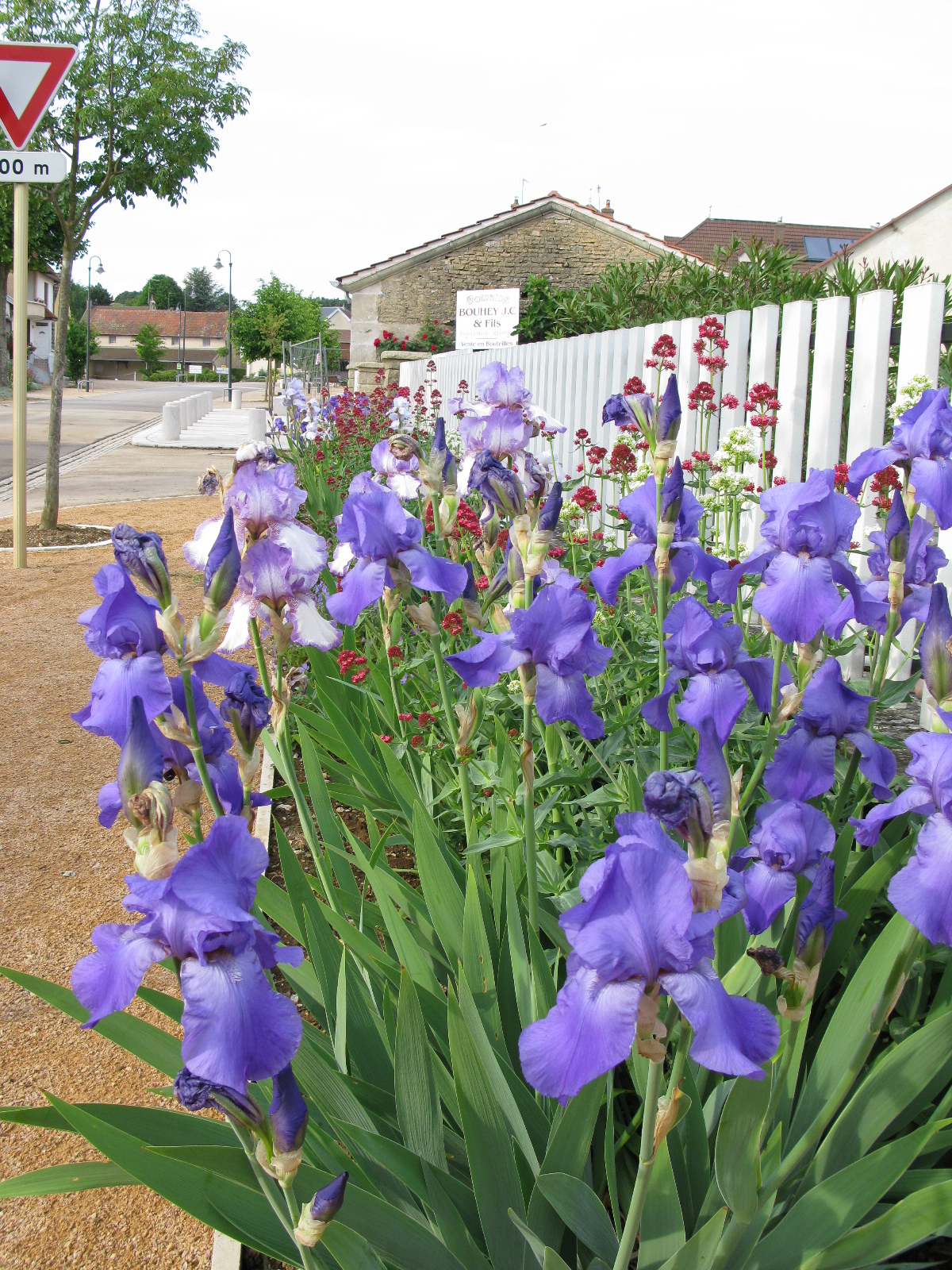
Back at Villers-la-Faye, Mary photographed a couple of iris gardens.  Burgundy is apparently perfect for iris.  They are everywhere and in copious quantity.  Enjoy.  The restored wine press is just at the end of our street, steps from our door and on the way to the boulangerie.
I thought these were an unusual color and especially pretty.

We shopped and cooked for dinner, a simple but delicious meal of saucisse aux herbes, sausages with herbs and sautéed vegetables along with a fresh salad.  We finished with a fromage called Palet de Bourgogne, a simple and inexpensive but nice local cheese.
We opened the Savigny-lès-Beaune Clos des Guettes we purchased a few days ago at Domaine Henri Villamont.  It was delicious, not extremely complex, especially at such a young age, but it was nice with the dinner and we enjoyed having a local wine with local food.  Here are my notes on the wine.
Domaine Henri Villamont Savigny-les-Beaune Clos des Guettes 2008. This was a wine of excellent structure and compatibility with food.  Although we opened it very young, I can tell it has great potential for aging for several years.  The aroma profile was mostly red fruit, but also had notes of earth and minerality.  The palate was smooth, not silky, considering its age, with great acidity and medium body.  The flavor profile was tart red cherry, raspberry, and a little spice on the finish.  Nicely balanced, moderately complex, medium length, needs much more time to reveal itself.  13.0% alcohol.  We paid €20 for this wine.
That’s our post for today.  We hope you enjoyed it and that you find our reports from France interesting.  Keep checking back at Cépage et Cuisine as we share more wine and food experiences.  In the meantime,
Cheers!
Mary♥Brian


Sunday, May 15, 2011

May 10, 2011 France Adventure

Bonjour a tous!  Hello, all, and welcome again to Cépage et Cuisine, Mary’s and Brian’s wine and food blog.  After a stroll to the boulangerie for a fresh croissant for Mary, we hurried to make our only wine tasting appointment of the day, which was at Domaine Tollot-Beaut in the village of Chorey-lès-Beaune.


I acquired a bottle of Tollot-Beaut a couple of years ago, enjoyed it very much, and since then read several articles about the domaine.  It is another relatively small but prestigious producer, old and multigenerational, now managed mostly by Madame Nathalie Tollot and a cousin and an uncle.  They don’t have a website, nor do they welcome visitors who are not already customers, which she made a point of telling us.  Determined as I am to experience great Burgundy, we wrote a letter to her by hand, telling her how we admire her wine and asking if we could visit, mailing it to her over a month ago.  She appreciated that level of interest and invited us for a visit.
Once again, we arrived at a busy time.  She was busy in the bureau, the office, and her uncle and cousin were busy on the labeling and packing line, just the three of them working there, a small family operation known around the world for its great wines.  Madame Tollot was incredibly gracious and friendly, completely fluent in English, taking us to the cellar to taste through her most recent wines, patiently explaining the subtle differences in various vineyard sites and answering our questions.  She closed by offering a taste of two mature wines, including a Grand Cru.  It is a pleasant memory for us and we look forward to enjoying her wines in the future.
Across N74 from Chorey-lès-Beaune is the village of Aloxe-Corton, very beautiful and classically Burgundian in architectural style.  Here you see the mairie, the town hall, with its multicolored slate tile roof that is specific to Burgundy, and the steepled church in the photo below.
Aloxe is home to the hill of Corton, distinctive for the Grand Cru vineyards on its slope and its crown of dense trees.  The famous vin blanc or white wine Grand Cru vineyard is Corton Charlemagne, named for the king and emperor, Charlemagne, who claimed the vineyard as his own because it is where the snow first melts, indicating the most optimal sun exposure and best ripening of grapes.  The Chardonnays of Corton-Charlemagne have wonderful depth, richness, complexity, and length that distinguish them from lesser vineyard sites.
 
I’d like to briefly describe the crosses you see in these vineyard photos.  One is of a cross among the vines of Corton-Charlemagne, seen here in the photo on the left.  Many vineyards in Burgundy have crosses within them or at the edges and many have been there for centuries, such as the cross in the photo below where I’m standing at La Romanee, placed in 1723.  Monks of the Cistercian order managed the vineyards for centuries and believed God spoke through the earth.  Crosses were placed as an expression of their faith and asking God’s blessings on the vineyards and the harvests.  Over hundreds of years they learned that this area is perfect for Pinot Noir and Chardonnay.  They didn’t plant a wide variety of other grapes, in part because they believed such diversity would interfere with the clarity of God’s message.  They painstakingly determined that specific plots of land, called lieu-dit or climats, produced grapes and wines that were reflections of that specific place, a concept now termed terroir.  Some of the vineyards are quite small, as little as a few acres in the case of vineyards such as La Tache in Vosne-Romanée.  After the French revolution, the new government confiscated properties from the church and the nobility, auctioning them to new private owners, but many of these crosses remain as a beautiful reminder of the history of the land and the culture.
Continuing with the culinary and enology theme of the trip, lunch was at L’Etoile in Nuits-St-Georges.  This is a spot we discovered a year ago and wanted to return.  Mary loves the salade montagnard, which has jambon (ham), noix (walnuts), and warm pommes de terre, or potatoes, along with the usual salad greens.  Most people in these little sidewalk restaurants have what might be called house wine with their lunch, often served in a small pitcher as you see in this photo.  The wine is called Bourgogne Passetoutgrain which translates roughly to “every grape together,” not always with great attention to refinement or high quality.  The result is a simple, inexpensive, fruity, sometimes slightly rough and tannic blend of Pinot Noir and Gamay. 
Nuits-St-Georges is one of the larger towns in Burgundy and has been developed to attract wine and food tourism.  For our Georgia and Tennessee readers, think Gatlinburg, but with fewer Smoky Mountain snowglobe souvenir shops.


With no appointments for the afternoon, we decided to visit the Chateau du Clos de Vougeot.  The “mother house” of the Cistercian order, it is massive and old, constructed beginning in the 10th century.  It has a large interior courtyard with a sundial on the north wall and surrounded by the well, monks’ dormitory, and vat house.  The vat house contains two original wine presses which date to the 16th century and two from the 18th century.  “Le Bouchard,” a statue of a vineyard worker, stands in the courtyard of the vat house.  The chateau is completely within the clos, which is a vineyard enclosed by a wall.  Clos de Vougeot is the largest of the Burgundy Grand Cru vineyards, covering some 50 hectares, which in round numbers is about 125 acres.
Dinner was at Ma Cuisine in Beaune.  The restaurant, operated by a husband and wife, Fabienne and Pierre Escoffier, is popular among Americans and other international tourists.  There were several other Americans there and the couple seated next to us were British, spending a few days in Beaune on the way to their summer house in Greece.  Fabienne handles most of the cooking, which explains the name.  “Ma” is the feminine form of “my,” so the name of the restaurant could translate to “my cooking” or “my kitchen.”  By the way, the masculine form for “my” is “mon.”  If he was doing the cooking, the restaurant might be called “Mon Cuisine.”  Mary sometimes calls me “mon marie,” which is “my husband.”  I call her “ma femme,” which is “my wife.”  Ok, there’s your French lesson for today. Back to dinner. 
We were ready to build dinner around a white wine, so Madame Escoffier came to our table and discussed options.  Mary caught me intently studying the carte du vin, the wine list.  There is no printed dinner menu.  Instead, it changes daily and is all on a chalkboard, which you can also see in the photo.
On the recommendation of madame, we started with coquilles St. Jacques, scallops lightly seared in olive oil, sprinkled with parsley, and nested in a salad of bitter greens…delicious! 


The main course was skate wing, pan sautéed, served with a lemon caper beurre blanc and pommes de terre.  This is popular here, as we saw it in a grocery as well as on another restaurant menu.
Like most dinners in France, the next course was a plat du fromage, sometimes called assiette du fromage, or assorted cheeses. 


We both had coffee and Mary had a beautiful crème caramel, like a caramel custard.


Now for the wine.  After a couple of days of fantastic Pinot Noir with dinner and tasting, we wanted to have a white Burgundy with dinner.  I was ambivalent about a Chablis, which would be great with the scallops, or a Côte du Beaune, which might be better with the skate.  Once again, we followed the recommendation of Pierre and chose a Puligny-Montrachet village-level vin blanc, which turned out to be an excellent suggestion.  If you decide to travel to France and need advice on wine selections, I recommend following the suggestions of sommeliers or proprietors in the restaurants.  They are completely knowledgeable of both wine and food and how they interact to complement one another.  They impress me as being interested in the dinner experience, not trying to sell the most expensive wine.  They do sometimes ask how much you want to spend so they will know the limits of what to suggest, but I have been quite pleased with all the suggestions.  Here are my notes on the wine.
Domaine Louis Carillon et Fils Puligny-Montrachet 2006. The wine was expensive for a village level wine, even by restaurant prices, but it was, in fact, stunning and we are on vacation.  I certainly would not spend this kind of money for a village wine routinely.  If I didn’t know better, I would have guessed it was a premier cru.  The aroma profile was complex with creamy lemon, apple, hazelnut, and caramel notes.  With a little time in the glass, it revealed new layers of aromas with shifting prominence.  The palate was equally complex and evolving.  It was creamy, medium to full in body, with a kind of lemon meringue, green apple, pear, the same hazelnut quality, and what I might call allspice, especially on the finish.  The oak conveyed complexity without masking the fruit.  It was absolutely delicious.  The acidity was medium, not tart, perfect for balance.  I would describe the wine as beautifully harmonious, all elements in proportion, complex of aromas and flavors, and long finishing, just excellent.  It was a perfect pairing for the scallops and skate wings.  13.0% alcohol.  The restaurant price was €67.

That’s our post for today.  We hope you enjoyed it.  Check back frequently at Cépage et Cuisine as we share more of our wine and food adventures in France.  In the meantime,
Cheers,
Mary♥Brian