Sunday, January 9, 2011

Tuna with Olives, Tomato, and Herbs and Broccoli - Bell Pepper Gratin

Hello again, everybody, and welcome to Cèpage et Cuisine, Mary’s and Brian’s wine and food blog.  Today, we’re sharing a dish we discovered when shopping at a seafood wholesaler here in Jackson.  The original version is by Emeril Lagasse.  Mary modified it to suit our preferences.  It’s easy, satisfying, delicious, and different.  It takes a wonderful and nutritious food, fresh tuna, and dresses it up.  The vegetable side dish transforms fresh broccoli and bell pepper into a fantastic side dish.  Here’s Mary to talk about the preparation.
I love this tuna recipe because it’s fast and delicious.  Start with high quality fresh fish, of course.  The ingredients for the sauce are onions, garlic, plum tomatoes, pitted Kalamata olives, a few anchovy fillets, basil, parsley, and oregano.  
The seasoning is just grocery store seasoning mix.


Onions are sautéed in olive oil, then the other ingredients are added and cooked for 15 minutes.  Butter is added at the end and melted into the mixture.

Ingredients sauteed and mixed.

Butter adds richness and body.
The recipe calls for pan-frying the tuna, but we prefer grilling it outdoors.  Brian handles that.  For tuna steaks about an inch thick, 4 to 4 ½ minutes on each side over medium high heat will give you nice medium or medium rare tuna.  Spoon the tomato/olive mixture over the tuna.

I prepared a side dish of broccoli-bell pepper gratin, which baked while I made the sauce for the tuna. The gratin dish is quick and easy!  Steam the broccoli, then toss with a sliced bell pepper that was sautéed in a little olive oil.
The vegetables are put into a casserole dish, topped with a mixture of bread crumbs and generous (of course!) freshly grated parmigiano-reggiano cheese (not the green can!), and baked for 15 minutes.

Ready for baking

Hot out of the oven
Here's Brian on the wine. I think this wine cries out for Pinot Noir.  Pinot Noir!  Pinot Noir!  Can you hear it?  It is powerful enough to stand up to the complex flavors of the dish, but delicate enough that it integrates without dominating.  The wine I chose was a Russian River Valley Pinot by Kathleen Inman.  For those of you in Sonoma County, Olivet Grange Vineyard is right at the intersection of Olivet Road and Piner Road in Santa Rosa.  Kathleen is a believer in elegance, finesse, and balance.  She picks earlier than many California producers, so her wine is more feminine and understated, not too high in alcohol.  She encourages enjoying her wines in their youth in order to enjoy their vibrant fruit and freshness.   Here are my notes on the wine.

This wine is very solid, varietally correct, elegant, and balanced.  It is a pretty medium ruby in the glass, not inky dark.  It is nicely aromatic of cherry and earth notes.  The palate is completely smooth with medium to medium-minus acidity, well balanced, with cherry and spice notes.  I would describe it as a moderately complex wine, but the texture and balance are what make it such a pleasure to drink.  14.0% alcohol.  It is a terrific value at $20.


That’s it!  Dinner is served! 
Fresh, delicious, nutritious.
That’s our post for today.  Thanks for reading us!  Come back again for more wine and food adventures at Cèpage et Cuisine.
Cheers!
Mary♥Brian

Thursday, January 6, 2011

The Other Cabernet

Hello, everybody, and welcome again to Cèpage et Cuisine, Mary’s and Brian’s wine and food blog.  Today we’re posting a quick note and short description of what we might call the “other” Cabernet.  Cabernet Franc does not have the fame and prestige of its better known offspring, Cabernet Sauvignon.  That’s right…Cabernet Franc is the genetic parent of Cabernet Sauvignon, but doesn’t get the glory.  Cabernet Franc is one of the five Bordeaux reds and may be present in Bordeaux wines as part of a blend, but it reaches its greatest heights in its ancestral home, the Loire Valley of northwestern France.
Here's a map of France with the heart of the Loire Valley indicated by the teardrop arrow.
You can see that the Loire Valley is well north of Bordeaux and slightly southwest of Paris.  Cabernet Franc production is especially noteworthy in the growing regions called Chinon, Anjou, Saumur, and Bourgueil.  Wines produced from Cabernet Franc tend to be more elegant than Cabernet Sauvignon, a bit fleshier or softer in texture, more medium in body, and more perfumed of red berries and floral notes such as violet.  It pairs nicely with slightly less hearty dishes than are sometimes required for Cabernet Sauvignon.  Mary and I especially enjoy Cabernet Franc with a simple roasted chicken.  While it certainly would stand up to some red meat dishes, it also does well with rich fish such as tuna or salmon, especially if a rich sauce is involved.

The bottle above is a wine we enjoyed not too long ago during the visit of Mary’s delightful sister, Fran.  Fran was the photographer that day, too.  Thanks, Fran!  You may not find this particular producer in Jackson or where you live, but a good wine merchant will have a few selections of Loire red wines.  Try it.  We think you will be surprised and pleased.  Here are Brian’s notes on the wine.
Clos Rougeard Saumur Champigny 2004.  This was just a delightful wine, moderately complex, entirely easy to drink, not ponderous, and paired wonderfully with food.  It had nice Cabernet aromas of cedar, bacon, and red fruit, but also had lovely floral and mineral notes.  The palate showed a smooth texture, almost silky, with medium body and high acidity.  Red cherries, red currant, possibly pomegranate, and minerals characterized the flavor profile.  Definitely built for food, it was nicely balanced and had medium length.  Not amazing, but rock solid.  Perfect with roast chicken.  12.5% alcohol.  The low alcohol allowed us to enjoy a couple of glasses of a very good wine without feeling fatigued or dragging down the conversation.  We paid $30 for this wine.
That’s our post for today.  Thanks for reading.  Come back again to Cèpage et Cuisine for more adventures in wine and food.  In the meantime,
Cheers,
Brian♥Mary
 

Sunday, January 2, 2011

Sea Bass and Champagne - Happy New Year!

Hello, everybody, and Happy New Year!  Welcome back to Cèpage et Cuisine, Mary’s and Brian’s wine and food blog.  It was an eventful New Year’s weekend here in central Mississippi, including a severe storm with a tornado that caused damage in our area but, thankfully, no severe injuries or loss of life.  Mary and I enjoyed an evening at home for New Year’s Eve, then dined out Jan 1 for our 10th wedding anniversary!
Today, we’re talking about another of Mary’s culinary creations, baked sea bass with a lemon-herb breadcrumb topping. 

This is Mary--Brian says things like "Mary's culinary creations," but what I really do is work with recipes we find. This recipe came from the Food Network. Below are the ingredients: bread, butter, lemon, thyme, garlic and parsley.
I make my own bread crumbs from toasted whole wheat bread and then I cube the slices as small as I possibly can. I've tried using the food processor, but with only 2 slices of bread, it just tosses them around and doesn't chop them into small enough pieces.
Here’s the seasoned fish in an oval baking dish. Try to use a baking dish about the same size as the fish so the topping stays on top while baking. Add lemon juice, lemon zest and thyme. 
Melt butter in a saute pan and add garlic. Cook for a minute or two, take off the heat, and let the garlic flavor the butter. Add the bread crumbs and toss. Let the bread absorb the garlic butter. Add the parsley and stir all together.
Spoon the topping onto the fish. Bake in the oven for 15 minutes. 
Here's how it looks right out of the oven, and then on the plate.
I  made a honeycrisp apple risotto (maybe a future blog post) and garlic spinach as sides for the sea bass.  It makes a pretty plate of contrasting colors and textures and pairs well with our wine for the evening.  Here’s Brian again, discussing the wine.


In honor of the occasions of New Year’s Eve and our Jan 1 anniversary, we selected a Champagne to pair with this dinner.  Although often associated with celebrations, which is fine, sparkling wine performs well as a food wine with the right foods.  I enjoy sparkling wine, but Mary loves, loves, loves it and in the world of sparkling wine, Champagne is certainly the gold standard.  It is more expensive than other sparklers, no doubt, but the creaminess and complexity on a special occasion is worth it.
We chose a non-vintage Taittinger, a blend of 50% Pinot Noir, 35% Chardonnay, and 15% Pinot Meunier.  It is a white wine, of course, even though the blend is 65% red grapes.  That’s because the juice is pressed off the skins immediately after crushing the grapes and before fermentation.  A rosé Champagne may allow brief contact with the skins before pressing.  Perhaps sparkling wine is a good topic for a future blog post.  Here are my notes on the wine.
Taittinger Brut Champagne La Française NV.  Just what we expected, the nose showed nice lemon, apple and baked bread aromas.  The palate had a lovely creamy texture, refreshing acidity, and lemon citrus, green apple, yeast bread, and mineral notes.  Very nicely balanced, moderately complex, wonderful length.  50% Pinot Noir, 35% Chardonnay, 15% Pinot Meunier, 12.0% alcohol.  We paid $47 for this wine at Briarwood in Jackson.
Mary loved the Champagne so much she played with the bottle, cork, and cage for more photos, so here they are!
Et voilá!  Sea bass, baked with lemon-herb breadcrumb topping, apple risotto, and spinach, paired with a lovely Champagne on New Year's Eve.  And here we are the next evening at our happy anniversary dinner.
That's our post for today, our first of 2011.  Thanks for reading our blog.  We hope you enjoy it and find it interesting.  Keep checking back at Cèpage et Cuisine.

Cheers!
Brian♥Mary

Sunday, December 26, 2010

Wines of the Week (sort of)

Hello, everybody, and welcome again to Cèpage et Cuisine, Mary’s and Brian’s wine and food blog.  Today, we’re describing a couple of wines, the next installment of our unofficial wine(s) of the week.  These two wines are readily available, good values, and are versatile with food.
Sauvignon Blanc is hugely popular as an easy, not-too-expensive white wine.  Not usually complex, its racy acidity, citrus, and herbal grassiness make it an ideal wine for summer.  It is not summertime, obviously, but Mary and I have shellfish or flaky white fish such as tilapia, halibut, sea bass or something similar a couple of times a week.  Sauvignon Blanc is a terrific pairing for everyday cooking with light seafood or poultry.
Like many varietals, Sauvignon Blanc yields to the hand of the winemaker and is influenced by location.  In my experience, there are predictable flavor profile differences between, say, New Zealand, California, and the Loire Valley of France.  As long as it is not too gussied up with oak, I really prefer California Sauvignon Blanc.  It is not too fancy, but has just what I mentioned above…good acidity for food friendliness and delicious citrus and herbal aromas and flavors.

St. Supéry Vineyards and Winery is in the heart of Napa Valley, right on Highway 29 in Rutherford.  They specialize in Cabernet Sauvignon and Sauvignon Blanc.  What I especially like about their style of this varietal is that it is completely oak-free.  It is fermented and stored in stainless steel tanks until bottling, so the consumer is getting the grape in all its glory.  Here are my notes on this wine.
St. Supéry Vineyards Sauvignon Blanc Napa Valley 2008.  This is not a highly complex or ponderous wine.  It is just delicious with a plate of light fare, such as the paneed tilapia over lentils and carrots we enjoyed.  It is classic in its nose and palate of Sauvignon Blanc with white grapefruit and lemon citrus, grassy herbaceousness, and mineral notes.  The palate shows tangy, clean acidity on a light-bodied frame with the same citrus, herb, and perhaps a little bit of tropical fruit such as kiwi or lime citrus.  This particular version had a softness or roundness that makes me think it had a little neutral oak treatment, but the St. Supéry technical information at their website says it was all stainless steel.  It was beautifully balanced, modestly complex, with medium length.  It is an excellent example of a high quality California Sauvignon Blanc, a little different from other regions that produce this wine, and that's as it should be.  13.9% alcohol.  We paid $18 for this wine at Briarwood Wines in Jackson.  It is widely available.
The next wine is from a region that might not be familiar to many wine drinkers.  Cahors is an appellation in southwest France, southeast of Bordeaux.  The principal red grape of Cahors is Malbec.  Nowadays, we often associate Malbec with Argentina, but Malbec is actually one of the five traditional Bordeaux red grapes, the others being Cabernet Sauvignon, Cabernet Franc, Merlot, and Petit Verdot.  As is often the case when contrasting New World and Old World wines, the Malbec of Argentina is big, juicy, often quite ripe, and high in alcohol when contrasted with Malbec from Cahors.  It is a powerful and intensely dark wine, to be sure, but it retains balance and a degree of elegance in Cahors.  It is all a matter of preference, but personally, I prefer the restraint, balance, and food friendliness of this version of Malbec.  I think this wine would pair nicely with a wide variety of food.  We paired it with grilled chops with tomato bruschetta topping, garlic spinach, and garden peas (called crowder peas here in the South…Mary’s not wild about them).  A small plat du fromage of sliced Manchego from Spain for dessert was delightful with the wine.

By coincidence, a wonderful video that presents the wine, the food, the geography, and culture of Cahors has been posted to a terrific website on wine, Grape Radio.  Go to http://www.graperadio.com/ to view The Scent of Black.  I think you will find it interesting and enjoyable. 
This particular producer includes a dollop of Merlot to add fleshiness and complexity.  Here are my notes on the wine.
Clos la Coutale Cahors 2008.  This turned out to be delightful and a good value.  My brother brought a bottle to a family gathering last Labor Day and I remember being impressed by it.  I had seen it at Briarwood and kept thinking I should try it, but hadn't gotten around to it.  With decanting in the glass for a bit over half an hour, it evolved quickly from mostly briary fruit and licorice to also reveal a sort of underbrush character, perhaps sage and thyme, perhaps flowers, not sure.  The palate showed medium body, smooth texture, and good acidity, nicely balanced and was very approachable, even in its youth.  Bright red cherry, red and dark berries, the same herbal characteristics were all present.  Balanced, moderately complex, medium in length, a delicious wine we both enjoyed and will drink again.  80% Malbec, 20% Merlot, 13.0% alcohol.  We paid $19 at Briarwood Wines in Jackson.  Considering my brother in Chattanooga brought it to our Labor Day event and I also saw it here in Jackson, it must be readily available.
That’s our post for today.  We hope it is interesting to you.  Check back for more posts at Cèpage et Cuisine.
Cheers!
Brian♥Mary

Wednesday, December 22, 2010

Rack of Lamb and Ratatouille

Hello again, everybody, and welcome back to Cèpage et Cuisine, Mary’s and Brian’s wine and food blog.  Today, we’re talking about rack of lamb with ratatouille.  This dinner is a “candidate” dinner for a wine event we’re planning for January, which will highlight Cabernet Sauvignon and Cabernet-based blends.  We’ve done traditional dishes like steak, short ribs, and roasts for previous events.  They were all successful, but we wanted to try something a little different, something our wine friends probably don’t experience very often.
Mary grew up eating lamb in California.  She loves it, especially the leg of lamb her mom prepared around Easter.  Here in the South, though, lamb is not part of our regular dietary repertoire.  I don’t think I tasted it until I was grown and moved away from my hometown in Georgia.  Even now, I would describe my experience with lamb as very limited.  So, in the spirit of culinary adventure, off we went.
The ratatouille is also part of the adventure.  It’s tempting to stay with the tried and true sides with a dish like rack of lamb…potatoes, carrots, etc, but what the heck, let’s try something different!  While traveling in France last May, we encountered a vegetable dish in the southern Rhone region that they called simply, légume du jour, or vegetable of the day.  It was chopped vegetables, stewed or sautéed with Provençal herbs and spices.  It was served as a side with hearty foods like roasted meats.  Mary loved it and with some online research, we decided it was ratatouille.  She has made it several times, always delicious.  One of the lamb recipes we saw suggested it, so we decided to try it as a single side dish to accompany the rack of lamb.
I think Mary should go into business as a food photographer!  Here she is, discussing the preparation -- These are the ingredients for the ratatouille.  Considering the vegetables in the picture above, I knew that ratatouille was a great summer dish, when everything is in season. I wasn't sure I'd find what I need in December, but I was happy to find eggplant and zucchini are still available.  Plum tomatoes, bell peppers, parsley, onion, and garlic complete the picture.
Here are the ingredients for the main course: the rack of lamb, garlic,
good olive oil, fresh rosemary and fresh thyme. It's really an easy dish to prepare.
The rack of lamb was marinated for several hours in a combination of olive oil, garlic,
rosemary and thyme.  Once that was in the fridge, I turned my attention to the ratatouille.
Eggplant, zucchini, bell peppers, onions, tomatoes and garlic are chopped. I learned from Julia Child's book to slice and salt eggplant and zucchini and put on a paper towel to absorb much of the water so it cooks up better in the skillet. This particular recipe called for cannellini beans, which Brian and I really enjoy, but the authentic ratatouille we had in France was strictly vegetables and herbs.  Either way is delicious!
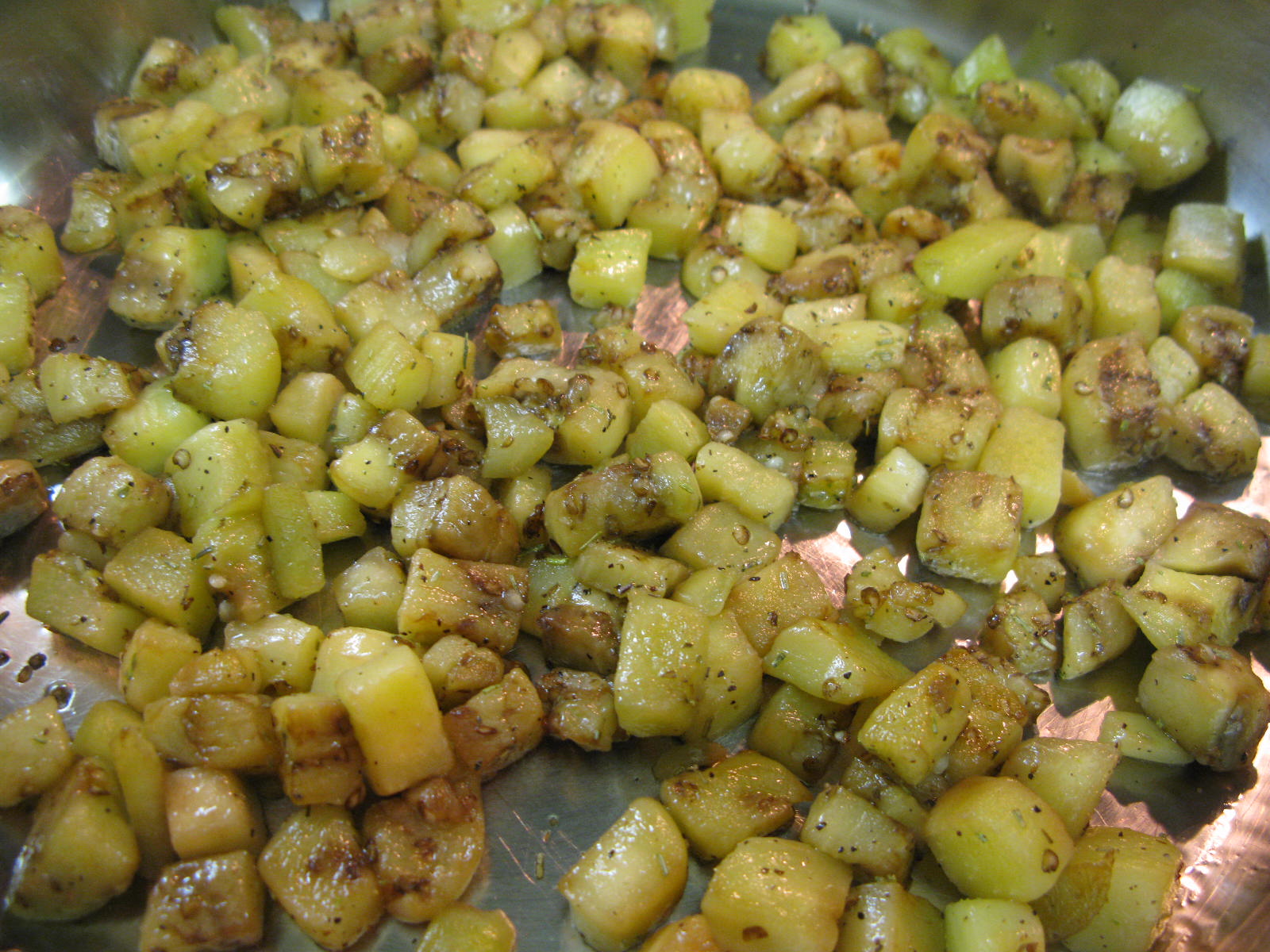
First I sautéed the eggplant in olive oil. 
Transfer that to a small bowl, and sauté the zucchini (below).
Also transfer the zucchini to a small bowl, and sauté the onions and peppers.

Now the veggies stay in the skillet, and you just add the rest in layers: first the garlic ...
... then the tomatoes ...
... then the beans and parsley ...
This all cooks together for 15 mins or so, and then the eggplant/zucchini is added back and simmered slowly (covered) for 15-20 minutes. 
While the ratatouille was simmering, I seared the rack of lamb in a hot skillet in a little olive oil, browning both sides. The recipe suggested covering the bones with foil before roasting in the oven, so I did that and smothered the rack of lamb with the marinade. Into the oven it goes for 25 minutes.
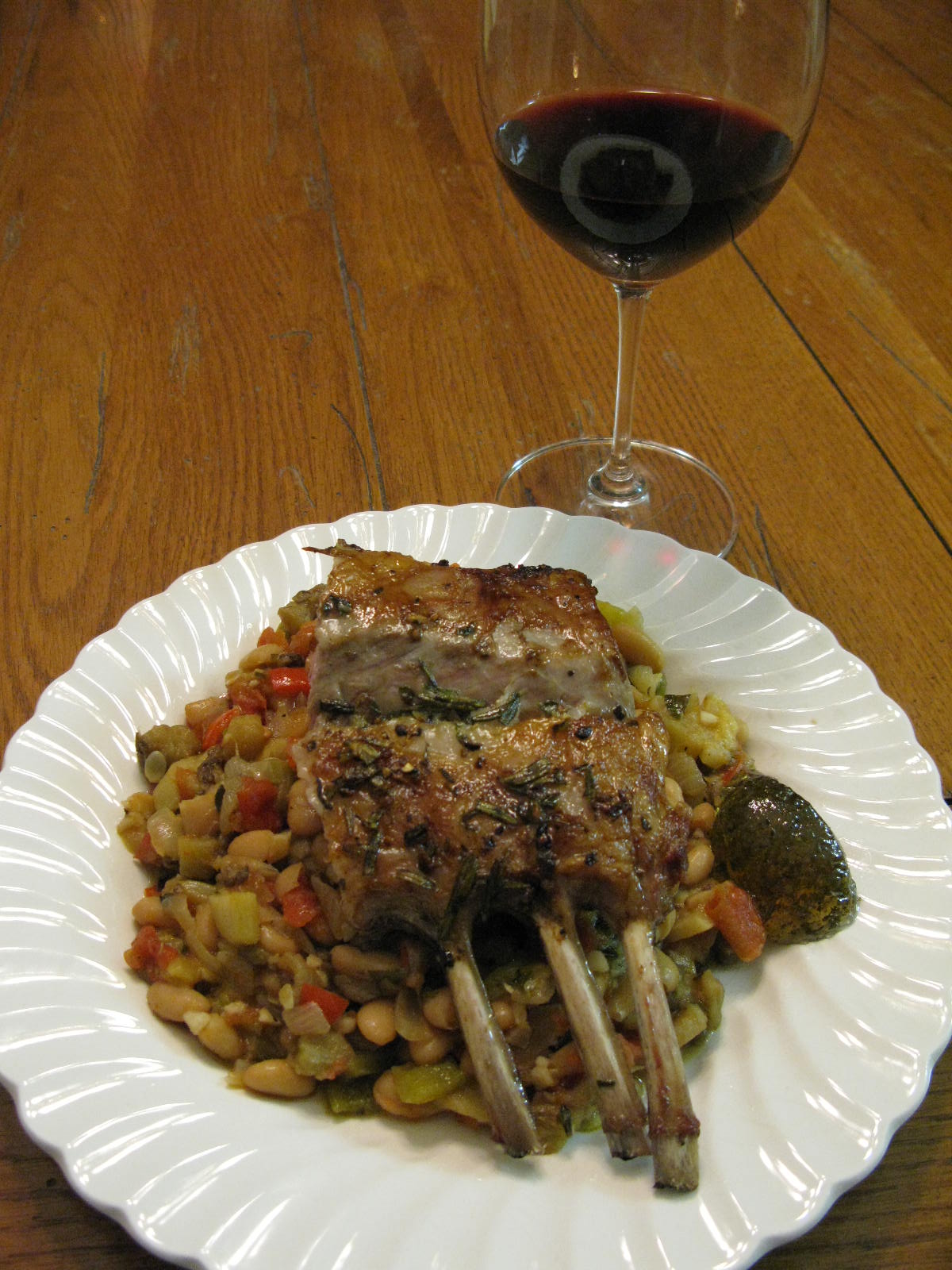
And here is the finished product.  It looks and smells fantastic!!
We are happy to report that it was delicious!

Now, back to Brian and the wine.  Since we’re considering this dinner for our Cabernet Sauvignon event in January, we paired it with a very traditional Bordeaux red.

Chateau Lynch Bages is a highly regarded producer from Pauillac, one of the prestigious villages of the Left Bank region of Bordeaux.  Like almost all Bordeaux, it is a blend of more than one varietal.  The cèpage is mostly Cabernet Sauvignon, but also includes Merlot and Cabernet Franc.  This bottle is quite mature.  As you can barely see on the label, it was the 1994 vintage.  Here are my notes on the wine.
Chateau Lynch Bages Pauillac 1994.  This wine was probably a bit past peak.  Its aromas were muted at first, but with time in the glass, the wine opened to reveal wonderful currant, cedar, graphite, and mineral notes.  The palate was medium in body, had medium acidity, smooth texture, and flavors of red cherry, currant, and herbs.  It was nicely balanced, moderately complex, medium in length.  I wish I had opened this wine a few years earlier.  It was delicious nonetheless.  The pairing with the lamb and vegetables was just about perfect.  The lamb and vegetables stood up to the power of the wine, maybe bringing out the fruit flavors of the wine even more.  Likewise, the wine did not mask or overpower the flavors of the dish.  The refinement, finesse, and elegance of a mature Bordeaux heightened the flavors of the overall dish, creating a flavor synergy that cannot be obtained with only the food or only the wine.  73% Cabernet Sauvignon, 15% Merlot, 10% Cabernet Franc, 2% Petit Verdot.  13.0% alcohol.  We paid $65 for it.
Voilá!  There you have it!  Rack of lamb, ratatouille and Chateau Lynch Bages 1994.  The finishing touch is mint jelly on the edge, which adds a wonderful punch of flavor (so says Mary).  Mary swooned over the deliciousness of the dinner.  I think her mind was floating back to those great childhood leg of lamb memories of 35th Ave in San Francisco and all her St. Gabriel and Presentation friends, but wherever she was, here or there, it was a happy place.  I think we can safely say this is the winning candidate for our Cabernet event.

Thanks for reading the blog.  Let us know what you think and offer suggestions for future topics.  We'd love to hear your comments.  In the meantime, keep checking back at Cèpage et Cuisine.
Cheers,                                                                
Brian♥Mary