Wednesday, December 15, 2010

Do You Come Here Often?

Hi, everybody, and Happy Holidays.  Welcome back to Cèpage et Cuisine, Brian’s and Mary’s wine and food blog.
This is the first of what we hope will be approximately weekly posts on specific wines or wine types, sort of a wine of the week.  This week we’re highlighting two wines.  The first is La Vieille Ferme, one of the labels under the umbrella of the Perrin family that makes Chateau de Beaucastel in the Southern Rhone Valley of France. 

The red wine of La Vieille Ferme is from the Côtes du Ventoux, usually a blend of Grenache, Syrah, Carignane, and Cinsault.  The white is from Côtes du Luberon and is a blend of Grenache Blanc, Bourboulenc, Ugni Blanc, and Roussanne.  They also produce a rose’ of Cinsault, Grenache, and Syrah.  The wines are all delightful and usually priced around $10.  They are widely available at any good wine merchant.  While they are entirely drinkable and serve well as a sort of house wine, they are inexpensive enough to use as cooking wine in recipes that call for dry red or white wines.  The La Vieille Ferme red has notes of red fruit, minerals, and pleasant earthiness.

The other wine you see here is a Petite Sirah, produced by Christopher Creek Winery in the Russian River Valley area of California, near Healdsburg.  Let me tell you, there is nothing petite about Petite Sirah.  The grapes are small, but the skins are thick and the wine is highly structured with immense tannins and intense fruit flavors of blackberry, boysenberry, plum, and spice notes, great for comfort food like burgers, nachos, pizza, and hearty soups around the holidays.  Mary even put a little Christmas bell on there to celebrate the season.  Christopher Creek is not widely distributed, especially here in the eastern U.S., but a good wine merchant will have other good selections of Petite Sirah for you to enjoy.  The Christopher Creek wine is $30, but good examples of Petite Sirah are available for under $20.
That's our post for today.  We hope you enjoyed it.  Let us know what wines you are enjoying during the holiday season and the kinds of food you pair with your wine.  In the meantime, keep checking back here at Cèpage et Cuisine for more posts.
Cheers and Happy Holidays!
Brian♥Mary

Sunday, December 12, 2010

Coq au Vin

Hello again, everybody.  Here we are again at Cèpage et Cuisine, Mary's and Brian's wine and food blog.  Once again, Mary has prepared a delicious dinner based on a recipe from Julia Child's Mastering the Art of French Cooking.  This time, she made Coq au Vin, which is basically translated to chicken and wine.  If you saw our previous post on Boeuf Bourguignon, Coq au Vin is the poultry equivalent.  It is classic French country cooking, satisfying, delicious, rich and complex.  It has many of the same ingredients and same steps, but doesn't take quite as long as Boeuf Bourguignon.  We visited France last year and have served this dish to people who know French cooking.  I think and our friends think Mary's cooking is just as good as the French.  Vive la Mary!
Here's Mary:
The ingredients for this dish are basically a whole chicken, already cut up, bacon, mushrooms (champignons), pearl onions, garlic, and herbs.  Red wine, chicken stock, Cognac, and tomato paste add to the flavor complexity.
The bacon is browned in butter in a Dutch oven, then the chicken is added in small batches and browned. Once all the chicken pieces are browned, simmer all of it in the pot for 10 minutes.  The only liquid in the pot at this point is the fat from the butter, the bacon, and the chicken.
About a quarter cup of Cognac is added and ignited.  The vapors of the Cognac are volatile, so the match or igniter can be placed just inside the dutch oven and it will light right up.  We tried to take a photo, but the flame is a pale blue, hard to see.  The pan is shaken and the flame dissipates quickly, leaving only the flavor elements of the Cognac.
I added three cups of red wine, which is basically a regular size bottle of wine.  Here, you see Brian pouring from a one cup measure because we finished off one bottle of wine and used part of another, so we were trying to be a little precise.
After the wine, I added enough chicken stock to cover the chicken.  As I have said in earlier blog posts, homemade stock makes such a noticeable difference in the quality of the dish when it comes to the table.  You can buy chicken, make the stock, then freeze it for future use.  In this photo, you also see the herbs, bay leaf, and tomato paste.  The chicken is simmered for half an hour, then the chicken pieces are taken out (and kept warm) while you reduce the liquid. This is the tricky part for me, as it doesn't always get as thick as it's supposed to get.   


Here is the final product.  You see I paired it with parsley potatoes and peas.  You can use whatever you prefer as side dishes.  These peas are called lady peas here in the South.  We grew our own parsley in a pot on our deck, perfect for wintertime.

Here's Brian again, talking about the wine.
You might think a chicken dish always calls for a white wine, but Coq au Vin actually pairs much better with red wine, which Julia also recommends in her book.  Plus, the dish is cooked with red wine.  Many wines would be excellent choices, but we selected a powerful California Cabernet Sauvignon to see how the dish would stand up to a really robust wine.  It turned out to be an excellent choice.  The richness and complexity of the dish was every bit the match of the wine.  The fruitiness and softness of the wine from Sonoma Valley created a flavor sensation that was just wonderful on the palate.

B.R. Cohn is a producer in the Sonoma Valley of Sonoma County, not far from the town of Sonoma on Highway 12.  Olive Hill is a vineyard on their property and that's where the grapes for this wine are grown.  They even produce their own olive oil right on the property.  This wine is 100% Cabernet Sauvignon.  We purchased the wine at the winery on one of our wine vacations.  It has been lying in our cellar for at least seven years, waiting for this dinner.  Here are my notes on the wine.

Definitely New World in style, it was delicious, nonetheless.  The aroma profile was not distinctly Cabernet, but it had lovely dark cherry and plum on the nose.  It didn't have the cedar, herbs, or tobacco of many Napa Valley or Bordeaux wines.  The palate had good structure, even a bit drying, indicating the tannins were not fully resolved, but the texture was very smooth anyway.  The acidity was on the low side of medium, but the wine was nicely balanced.  All that California sunshine came through with cherry, plum, and currant fruit.  It was nicely balanced, moderately complex, and medium in length.  I would describe it as a good wine, bordering on excellent.  We agreed it was delicious.  14.0% alcohol.  We paid $40 at the winery.

That's our post for today.  We hope you enjoyed it and that our posts are interesting to you.  We'd like to hear your comments and ideas!  In the meantime, check back again for more blog entries at Cèpage et Cuisine.

Cheers,


Brian♥Mary

Sunday, December 5, 2010

Boeuf Bourguignon - So Much More Than Beef Stew!

Ok, everybody, let the juices flow and the lip smacking begin!  Welcome again to Cèpage et Cuisine, Mary’s and Brian’s wine and food blog.  We want to share with you a classic dish Mary prepared recently during a visit by her sister, Fran, and our friends and neighbors, Mike and Dorothy.  Boeuf Bourguignon really is so much more than beef stew.  This recipe is pretty much lifted from Julia Child’s Mastering the Art of French Cooking.  Julia’s recipe takes up three pages of the book and includes about 20 ingredients.  Some of the ingredients even have their own recipe with more ingredients!  It is a bit of a project, so think in terms of a weekend or a special occasion, even though it is essentially French country cooking.  Without rushing, it is a two day project if you make your own stock from scratch.  It is rich, delicious, and satisfying.  So, here we go!
Here are the basic ingredients, not all.  For example, you don't see the oils and butter.  The key element is the beef, of course.  As Julia recommends, we use rump roast.  Your butcher can cut it for you into small chunks.  You also see bacon, carrots, onion, garlic, pearl onions, mushrooms (champignons), and herbs.  The jar is homemade beef stock.  A word about that... Real beef stock, like real chicken stock, makes a huge difference in the richness and flavor of the dish.  It takes time, but it's worth it!  You can buy neck bones or other parts at the meat department of your supermarket and combine that with vegetables and seasonings to make something special.  Make a big pot and freeze it!  Recipes for stock are widely available.
Put the beef on paper towels to dry it so it will brown nicely.  If you don't, then the beef gets steamed in the pan, instead of browned.
The bacon is cut into small pieces, then cooked in a Dutch oven.  The bacon provides flavor and fat for cooking other ingredients.
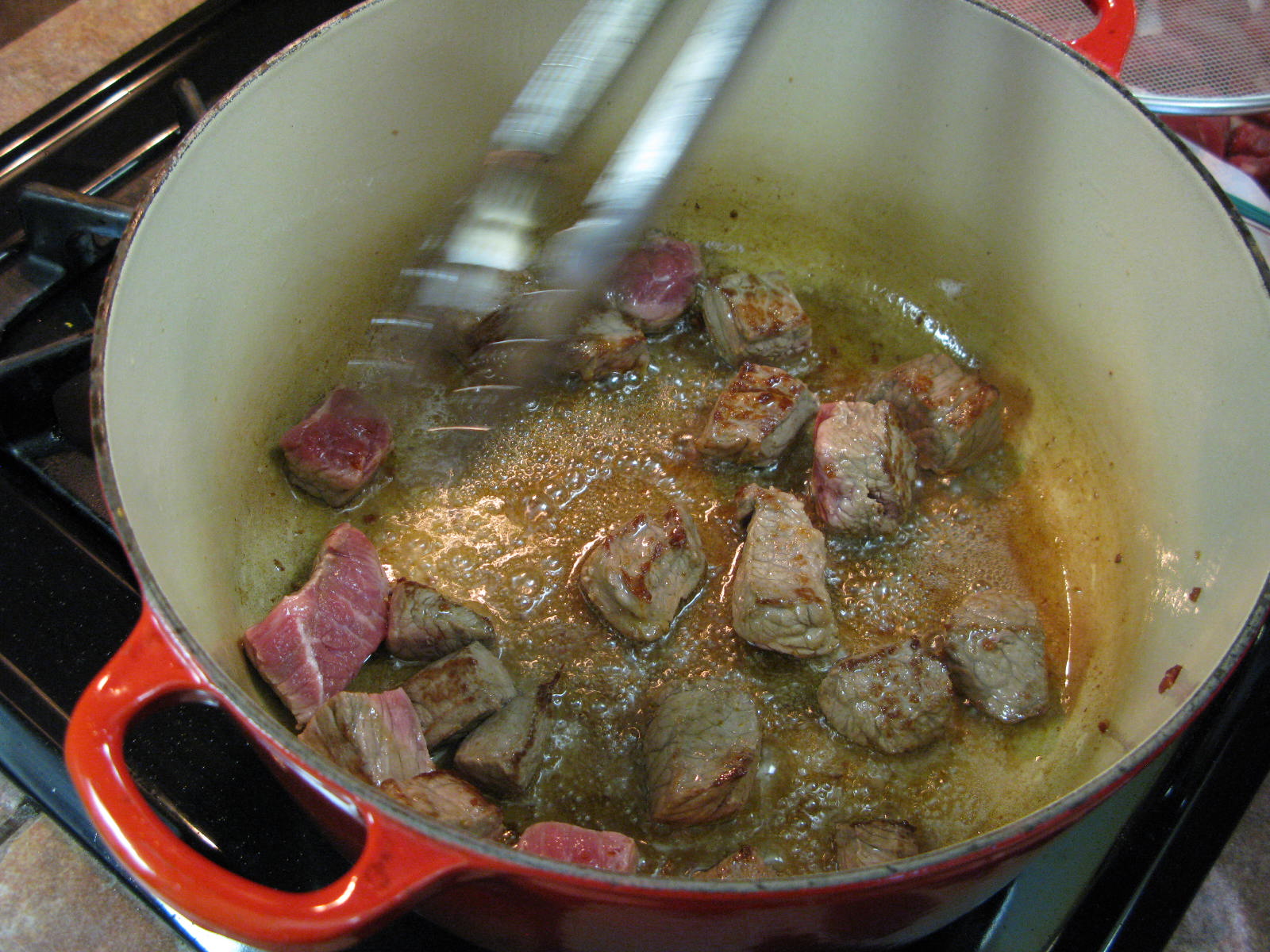
The beef is browned a few pieces at a time so they are not crowded and not touching in the pan.  Once again, this is important for browning, not steaming.
The bacon and beef have been removed.  Onions and carrots are cooked in the remaining fat until browned.  The meat is returned, seasoned with salt and pepper, and the flour added and tossed.  The pot is put into the oven for four minutes at 450 degrees, then the mixture is tossed, and cooked four minutes more to create a nice crust.,
The pot is removed from the oven and the entire bottle of wine is added, then the beef stock to cover the meat.  This is the braising liquid.  Once again, the extra time and effort to make beef stock will be worth it.
Let it braise!
While the beef is cooking, the onion and mushrooms are prepared.  The onions are blanched, cooled, husked out of the peel, cooked in olive oil and butter (wow!), then the frying pan is placed in the oven for an hour.  The mushrooms are sliced and also cooked in olive and butter (wow, again!) for about 10 minutes.  This can be done when things are almost ready.
Here's a class photo.  See how everybody is getting happy?  This is just before the assemblage.  The mashed potatoes form a bed for the beef braise, and topped with mushrooms, onions, and green peas.  Once again, here's the final product:

Here's the happy crowd!
Now, a word about wine.  Many red wines would pair just fine with this dish.  One might think intuitively that a red Burgundy would be the logical choice since the dish is native to Burgundy. I selected a Bordeaux-style blend, however, from a mountainside appellation in Napa Valley.  Here's a photo:
This wine is by Random Ridge Vineyard on Mt. Veeder, high above the Napa Valley floor.  I have blogged previously about Mt. Veeder.  It is a remote, rugged area, tough on grapes, so they produce intense flavors.  This wine is a blend of half Cabernet Sauvignon and half Cabernet Franc.  It is a mature wine, 1993, and was poured from magnum, equivalent to two regular 750 ml bottles.  Here are my notes on the wine:

Random Ridge wines are always a pleasure, always complex and balanced, and age beautifully.  Here is a 17 year-old wine that is elegant, beautiful, seamlessly compatible with food, a treat.  It had a medium garnet color and wonderful aromas of cedar, leather, sage and other herbs, possibly some violet, currant, and dark cherry.  I think the Cabernet Franc brings a distinctive floral note to complement the Cabernet Sauvignon.  The Cabernet Franc also adds a little softness to the wine, although after this much time, it has pretty much settled to a lovely refinement anyway.  The palate was silky smooth with medium acidity and exquisite balance.  Bill didn't include the alcohol percentage on his wines back then, but I would guess high 12s to low 13s.  Red currant, the same cedar, leather, and herbal qualities, and red cherry appear on the flavor profile.  Wonderfully balanced, complex, and a finish that lasts well over a minute make this an excellent wine.  50% Cabernet Sauvignon, 50% Cabernet Franc, alcohol not labeled.  We paid $55 for this wine.

It was quite a production.  Mary invested her creative energy providing a fantastic dinner for us.  Hail to the chef!  Thank you!

That's our post for today.  The food was divine, the wine was beautiful, the friends, family, and conversation warm and convivial.  That's what it's all about, isn't it?  Thanks, Fran, for your expert photography! Check back for more blog posts at Cèpage et Cuisine.  In the meantime,

Cheers,

Brian♥Mary


Sunday, November 28, 2010

Yorkshire Pudding

Hi, folks, and welcome back to Cèpage et Cuisine, Brian’s and Mary’s wine and food blog.  Today is a bit of Thanksgiving redux and a preview of festive holiday dishes to come.

Anyone who has read A Christmas Carol by Charles Dickens or read about traditional winter and Christmas dishes of 18th and 19th century England has heard of Yorkshire pudding.  Mary and I confess we knew nothing about it until we made it recently as part of our Thanksgiving celebration.  Even at that, the recipe was called popovers.  We didn’t realize it was actually Yorkshire pudding until we did more research.  Gosh, we thought it was some kind of pudding for dessert!  But it’s only the batter that’s like a pudding!
Yorkshire pudding was a way of making use of the drippings of roasted meat.  The hot fat, the hot pan, and a batter not unlike pancake batter combine to produce a bread-like muffin that is traditionally served with savory, hearty meals.  According to Wikipedia, one of the first recipes, called “A Dripping Pudding,” was published in 1737 in a book called The Whole Duty of a Woman.  Enough said about that and I’m not touching it with a ten-foot pole!
Today we use handy-dandy nonstick muffin pans, the fat is butter or oil, and we have fan-driven convection ovens, but the results are still delicious and complement a traditional holiday meal.  We got the idea for our dish from an article by Mark Bittman, a food writer for the New York Times.  Credit due where credit is deserved, I always say.
The dish is easy, interesting, and different from the usual brown ‘n serve rolls in the little paper box.  Our granddaughter loved our creation!  The ingredients are probably already in your kitchen as you read this post ... butter, eggs, milk, sugar, salt, flour, and herbs.
Well, here's how easy it is.  Melt a little butter in the muffin pan while you make the batter, which takes only a couple of minutes.  Beat the eggs, milk, a little melted butter, sugar, and salt together.  Beat in the flour and herbs to a smooth batter.  Take the muffin pan with melted butter in each cup out of the oven and pour a quarter cup of batter into each cup.  Bake for 15-20 minutes at a preheated 425 degrees, then reduce to 350 degrees for 15 more minutes without opening the oven door.  It’s really interesting to watch them “pop over.”  Remove from the pan immediately and serve hot.  They don’t stay poofy and light very long.  Here's a series of photos from our experience.
We used whole wheat flour, but regular all purpose flour is fine.  Fresh herbs are best and thyme is a good choice.  If you use dried herbs, use a smaller quantity.
Here's the batter just after it is put into the oven.  The photo was taken through the glass in the oven door.  Don't open the door while cooking!
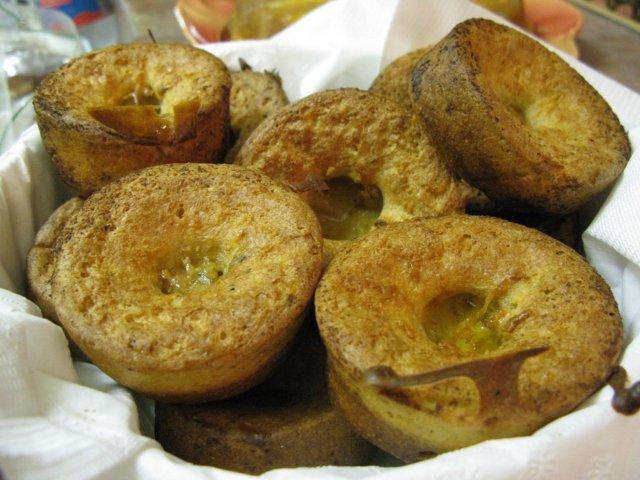
They really do pop over!  It is interesting to watch.  Now here's the finished product again as it went to the Thanksgiving table.
The recipe isn’t hard to find and there’s a great video by Mark Bittman at www.nytimes.com .  You can also post a comment here at the blog and I’ll be glad to email the recipe to you.  You’ll feel so….Dickensian.  Don't worry ... your email address won't appear on the blog.
That’s our post for today.  Let’s have a great holiday season, appreciating each other, great food, fine wine, friends and family, and all our blessings.  Keep checking back for more posts at Cèpage et Cuisine.  We’d love to hear your comments and ideas.  Let us know about your wine and food enjoyment for the holidays.  Until then,
Cheers,
Brian♥Mary

Sunday, November 21, 2010

Thanksgiving Wine Suggestions

Hello, everyone, and welcome back to Cèpage et Cuisine, our wine and food blog.  Today, we’re offering tips and suggestions on Thanksgiving wines.  We had our holiday family gathering a few days early, but everything else about the event was very traditional.  Here’s the star of the show.
If your family gathering is anything like ours, it was a delightful houseful of guests, happy noise, college football (it was a good game, but Ole Miss lost), and granddaughters scampering around in our arms and underfoot.  Mary and I were tag teaming in the kitchen from the moment we got out of bed in the morning until late at night when we finished the cleanup.  Here’s the menu:
  • appetizer of butternut squash soup
  • roasted turkey (free range, no hormones, treated humanely, Dan)
  • gravy from turkey stock
  • sweet potatoes
  • Cajun-style cornbread dressing (of course)
  • navy beans
  • turnip greens
  • cranberry sauce
  • black olives
  • popovers (our first attempt at this...will have to blog about it sometime)
  • pumpkin pie
  • pear tatin
Somehow, we pulled it off, got everything on the table at basically the right time.  It was all delicious, everyone enjoyed it, and we had a nice time to count our blessings.  Now, about those wine suggestions…..
Suggestion #1:  Don’t fret about the wine.  Drink the wine you like with the food you like.
Suggestion #2:  Don’t spend a lot on the wine and don’t open “special” wines for a crowd.  Most people probably aren’t all that into wine.  Plus, the focus of the day is not the wine.  The wine is just an enhancement.
Suggestion #3:  It’s probably best to offer both a white and a red.
Suggestion #4:  It is likely that some guests will not partake of the wine at all, but to make sure you don’t run short, think about one bottle for every two or three guests.
About specific wines, we’re not going to suggest specific producers but broad themes.  With a complicated meal, a riot of flavors, the blank canvas of the bird, spicy and savory flavors of the side dishes, choose versatile wines that go with a wide variety of foods.
On the white side:
  • Riesling is perfect, whether a dry version from Alsace, one with a bit of residual sugar from the Mosel region of Germany, or good examples from Anderson Valley in Mendocino County, you can’t go wrong with Riesling.  The citrus, peach, apricot, honey, and mineral notes blend seamlessly with turkey and the fixins.
  • Gewurztraminer is a wine that seems to have been made for Thanksgiving.  It is redolent of rose petals and a delightful spiciness.  Like Riesling, it is produced in dry and sweet styles.
  • Southern Rhone whites such as Viognier, Roussanne, Marsanne, or blends are also excellent, but can be a little pricey.  Shop carefully.
  • A sparkling wine would be festive and wonderful.  Champagne is too expensive for a crowd.  Think about a Spanish Cava, Italian Prosecco, or a sparkler from California or Oregon.
  • A Chardonnay would work, but might not be quite as versatile as the other whites.  Try to avoid really oaky Chards, which can make shopping for a Chard difficult at Thanksgiving, especially if you're trying to be price conscious.
On the red side:
  • Pinot Noir is one of the most versatile reds, but also a bit pricey for a Thanksgiving crowd.  It offers great aromas and flavors of red and dark fruit, earth, autumn leaves, and mushrooms.
  • A Cru Beaujolais is bright, juicy, and fruity, easy to drink, not a complicated wine, can’t go wrong with this one.  Cru Beaujolais is a step up from Beaujolais.  Once again, shop carefully.
  • Zinfandel (not the pink) is the all American red.  Think big fruit, rich texture, adding another layer to the complex dinner menu.  A word of caution….Zinfandels can be high in alcohol, so tread lightly.
We suggest you save the other classics like Cabernet Sauvignon and Syrah for another day, but if you like ‘em, drink ‘em.
This is all the tip of the iceberg, of course, and there are other great choices.  Post a comment here at the blog and tell us about your Thanksgiving menu and wine choices.
Here’s a photo of Mary’s first attempt at pear tatin, sort of a pear upside down cake, famous in the Loire Valley of France.  As you can see, it turned out great!  Compliments all around to the chef!
She's such a wonderful chef.  I love to brag about her.
That’s our post for today.  We hope you and your family have a wonderful Thanksgiving.  Keep checking back for more posts about wine and food at Cèpage et Cuisine.  In the meantime,
Cheers and Happy Thanksgiving!
Brian♥Mary

Sunday, November 14, 2010

Evolving Wine Styles - Temperature Rising!

Hello again, folks, and welcome back to Cèpage et Cuisine, our wine and food blog.  Today, we're discussing the trend for riper, bolder wines with higher alcohol levels over the last decade or more.  Take a look at these two wine bottles.  What differences do you see?

Well, the obvious difference is the one on the right is empty!  A slightly closer look tells us the wine on the left is a Merlot and the wine (fomer wine) on the right is a Zinfandel.  These are both California wines.  Let's take a closer look.


The Merlot is produced by Mayacamas Vineyards on the steep slopes of Mt. Veeder, above Napa Valley.  It is classified as a Napa Valley wine.  You might recall an earlier post about another Mt. Veeder producer, Wing Canyon Vineyards.  Importantly, notice the vintage is 1995.

The Zinfandel is by Christopher Creek Winery, a producer in Sonoma County.  This wine is from the 2008 vintage.  The winegrowing appellation, the area where the grapes were grown, is Dry Creek Valley in Sonoma County, north of Healdsburg.

Beginning in the 1990s, many producers began to refine viticultural and winemaking techniques to create wines with bolder, richer flavors that are approachable and ready to drink upon release.  The historical model of wines is that they need time to evolve, to settle down, and for their complexity and subtle nuances to reveal themselves.  Well, Americans often expect to drink wines right away.  It has been said that the average length of time Americans age their wines is 20 minutes on the car seat!  It's a cute expression, but there is some truth in it.

Our culture often treats wine as a leisure beverage, to be enjoyed over casual conversation or relaxation, with or without food, what I sometimes call patio wine.  Wines with strong tannins or high acidity don't always lend themselves to this style of consumption.  Softer, rounder, richer, bolder flavors work well for this.  Europeans, on the other hand, have long viewed wine as first and foremost a beverage to enjoy at the table with food.  For this purpose, structure with tannins and acidity complement food, enhancing the dining experience, sort of 1 + 1 = 3.

Influential wine critics, especially James Laube, who reviews most California wines for Wine Spectator, and Robert Parker, who publishes the Wine Advocate, usually award high scores to the rich, ripe style.  That drives sales when consumers read their reviews and see those little shelf talkers in wine shops.  Faced with a bewildering array of wines, a high score means at least somebody liked it, so that wine gets selected.

The wheels on the bus go round and round.  Many people like easy, soft, bold, rich wines.  Laube and Parker bless them with high scores.  Consumers choose the wines with big numbers.  Producers must sell their wines in a very competitive market, so they try to make wines that will get high scores...   Riper wines have higher sugar levels.  Yeast ferments sugar to alcohol in the winemaking process, so higher sugar translates to higher alcohol.  Let's look at these two wines again more closely.
Mayacamas Vineyards is a very traditional producer.  Their wines are made in a traditional style, more like Bordeaux than Napa Valley in some ways, even now.  But look at the alcohol level on the label of this 1995 Merlot, 12.5%.  This is a wine that rewards cellaring and really needs at least a few years to show itself fully.  If you want to sip this wine by the pool, go ahead.  You might like it on its own...it is lovely, perfumed with violets, currant, and mineral notes.  But if you want to drink this wine over a long, lingering dinner of, say, beef tenderloin, grilled to medium rare perfection, or rack of lamb with mint, shared with friends or a special person, then you are in for a treat.


Now check out this baby.  In this corner! from Dry Creek Valley! checking in at 15.9% alcohol!, a contender for the Sonoma County Heavyweight Championship! Christopher Creek Winery 2008 Zinfandel !  LOL.

To be fair, Zinfandel is not Merlot.  It often requires higher sugars for adequate ripeness.  I recently read an article that quoted Paul Draper, one of the most noted Zinfandel experts, as saying that any Zinfandel under 14% alcohol has been artificially manipulated to lower the level.  So, it may not be completely fair to compare a 1995 Merlot with a 2008 Zinfandel, but it is a good example of how some wines have turned into monsters of jammy fruit and high alcohol.  Fifteen point nine percent!  Lots of people love this style and to them, I say that's great.  Drink the wines you like.  If you like it, it's good wine.  Zinfandel is great with comfort food....think pizza, burgers, nachos, ribs...and it's not usually highly expensive.

My problem with a wine like this is it leaves me fatigued after a glass or so.  Mary and I like to share a bottle of wine most evenings with dinner, talking about our day, enjoying each other's companionship, living life as we love it.  But after a bottle of a wine with alcohol this high, we just feel washed out and sleepy afterward.  As you saw in the first photo, it is an empty bottle.  Here are my notes on the wine.

The wine was not undrinkable, but it had the usual overblown, raisiny or pruney qualities of the modern style of too many California wines, especially Zinfandel.  The nose was dark plum, raisins, chocolate, and toast from the barrel.  The palate was full-bodied, low in acidity, with mocha-infused flavors of dark fruit, plum, jammy marmalade.  Not all that complex and not very friendly with food.  It was hedonistic and many people like this style, but I am not among them.  Modestly complex, a bit hot on the palate from the alcohol, not well balanced to me, medium length.  15.9% alcohol.
Ok, choose your style.  Maybe you like them both.  A lush, fruit-foward wine for simple relaxation and more restrained and elegant wines for dinner occasions.  Diversity of wine and wine preferences is wonderful.  I'm hoping the pendulum is beginning to swing back to a happy medium toward somewhat lower alcohols and better structure, but different wine styles will always be with us.  And that's as it should be.
And for the record, Mary and I have enjoyed many, many Christopher Creek wines on many, many occasions and look forward to doing so again.
That's it for today.  Thanks for following the blog!  Don't forget to visit us again at Cèpage et Cuisine.  In the meantime,
Cheers!
Brian♥Mary