Friday, June 20, 2014

France Adventure – Thursday, May 29, 2014 – American Connection in France

Bonjour tout le monde! Je suis votre blogueur convivial.  Hello, everybody.  I’m your friendly blogger.  Welcome back to Cépage et Cuisine, Mary’s and Brian’s wine and food blog.  Today we’re exploring the area near our gite in the commune of Montagne and nearby Saint-Christophe-des-Bardes and Saint Émilion.

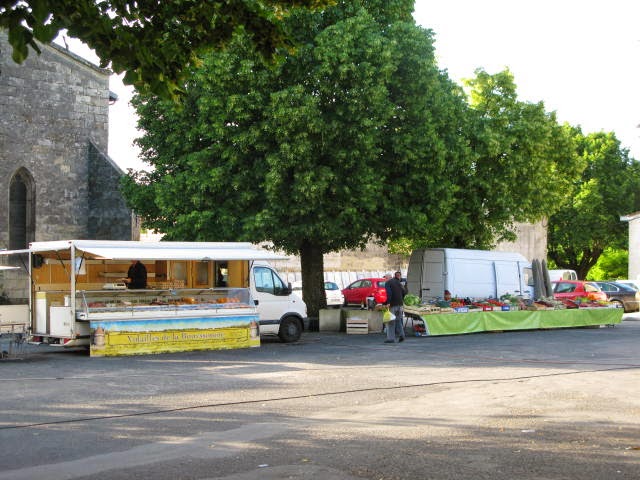
We started the day by driving to the nearby town of Lussac where we heard there would be a farmer’s market today.  There was, in fact, a market but nothing at all like the Beaune market.  It was a tiny market of a few vendors on Place de la République, the town plaza next to the church.

It was actually very pretty and very nice.  We were among the first to arrive when it opened at 8:00 a.m.  It was quiet, the vendors were having conversation, very laid back.  
The Beaune market is great fun with the crowds and variety, but this nice, small, laid back atmosphere was also fun.  Mary liked it because she could stroll up to the vendor and browse the selection without having to jostle elbow to elbow.

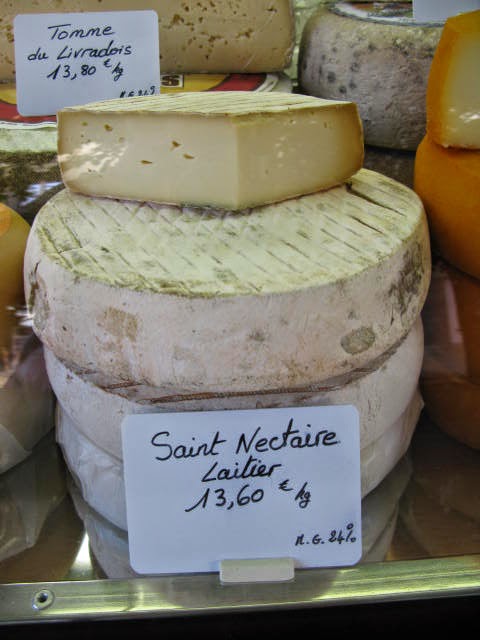
We picked up some meat, vegetables, fruit, and cheese for dinner in the gite later.

After the market experience, we passed through Montagne so you know what that means … yes, the boulangerie.  Mary was with me today so she could choose for herself.

Chocolatine or croissant, chocolatine or croissant, decisions, decisions.


Chocolatine, it is.

While jogging a couple of days ago I passed by a nearby estate, Clos de la Barbanne.  The vigneron was working in his vineyard and greeted me in French, then asked a question of some sort.  I gave him my standard reply, “Je parle en peu le Francais,” I speak only a little French.  So he said, “How are you?  Are you doing ok?”  We had a nice laugh.  

I stopped at their gate on the way back and his wife invited us to visit them and tour the estate.

We walked over this morning, all of perhaps 5 minutes from the gite to Clos de la Barbanne.  Here’s a great photo of the gite and Château Lys de Maisonneuve I snapped during the walk.  I mentioned in a previous post that the gite is part of a working wine estate.  Here you can see the gite, which is the two buildings next to our car.  The rest of it is the winery.  You can also see how it is completely surrounded by vineyards.  It’s just a beautiful location.
Clos de la Barbanne is a wine estate that is tiny by Bordeaux standards, only 1.7 hectares, less than 4.5 acres.  Originally from Alsace, Laurent and Annie Gerber settled here a few years ago after Laurent left a career in agribusiness, including living in Illinois and Iowa.  Laurent is the vigneron and Annie manages their luxurious bed and breakfast.

Laurent walked us through his vineyards and gave us an excellent history of the area and viticulture.  For example, we’ve seen these yellowed vines frequently on our travels.  Laurent explained that the soils in his vineyard are mostly clay and limestone.  When the limestone is very near the surface, the vines are less able to extract necessary phosphorus and potassium from the soil, so they turn this yellow color.  He manages this problem simply by applying a spray of phosphorus and potassium that is absorbed through the leaves.  He said the foilage turns green again practically overnight.
Here you can see that Laurent turns the soil in every other row, leaving a cover crop in alternate rows to promote biodiversity.

This beautiful view from Laurent’s vineyard shows a line of trees where the tiny La Barbanne flows.  That white gate on this side of the trees is the entrance to our gite.  Saint-Christophe-des-Bardes is up the hill on the other side of the La Barbanne.  That little river is the border between the communes of Saint-Christophe and Montagne.  Likewise, it is the border between two Saint Émilion satellite appellations.  They are Saint-Christophe-des-Bardes-Saint Émilion and Montagne-Saint Émilion.  Perhaps because it is just that much closer to Saint Émilion, the vineyards in Saint-Christophe, seen here just on the other side of those trees, are sharply more expensive.  A hectare of vineyard property over there is around €125,000 in contrast to about €80,000 on the Montagne side.  That’s about $175,000 per acre vs $110,000.

After the vineyard tour, Laurent took us to the chai, the small winery where he makes and ages his wine. His production is small, only about 500 cases per year.


Here’s his wine press.  Unlike other producers where these are shown to visitors as antiques that are no longer used, Laurent still presses grapes with this one.
Laurent opened a bottle of his wine, which carries the proprietary name, Concerto.  It is 90% Merlot and 10% Cabernet Franc.  Annie served a small lunch and we enjoyed conversation about their experience in the U.S. and France and their family.  The wine was delicious, fruit-forward with dark berry and plum and a round, velvety texture.  It would be great on its own and with food.

Our tasting appointment for the afternoon was Château Fonplégade in Saint Émilion.  We enjoyed a bottle from there years ago.  The tour and tasting was recommended to us by the owner of Les Marronniers.  It looks like the quintessential Bordeaux château, big, elegant, imposing. The construction work on the right is to build the second tower.  The original 18th century plans included two towers, but only the left tower was constructed until now.


This is the room where we met our guide, Amy.  
Not too many grand pianos when we taste in Burgundy.  Back in the small villages of the côte like Savigny-les-Beaune, it’s more likely to be an upturned empty barrel in the cellar.


Before we started our tour, Amy offered us a glass of the Château Fonplégade Fleur de Fonplégade rosé, a cool, refreshing quaff on a warm day.

Château Fonplégade was acquired several years ago by new owners who happen to be American.  The winery facilities were completely updated with new equipment and technology, including these massive oak fermentation vats.  The château is also being renovated as you can see in the exterior photo above.

Similar to what we’ve seen at some other châteaux, the vats have stainless steel coils that circulate water to control the fermentation temperature.


Here’s a high-tech, computer-controlled grape press.  It’s a far cry from the hand-cranked wooden press at a small estate such as Clos de la Barbanne.


And similar to other estates, here are stainless steel tanks for fermentation and/or blending.
Château Fonplégade has several of the concrete eggs for maturing wine.  As I mentioned in the post about Château Brown, the shape of the egg and the earth’s rotation create a vortex that keep the grape skins and other solids in motion inside the egg.  As a result, the wine extraction is improved without manual stirring.  The porosity of the concrete allows a tiny exchange of oxygen, similar to what might be obtained with oak barrels.
The barrels are stacked on these racks with wheels to allow easy access.


A control panel regulates the temperature in the cellars and barrel rooms.
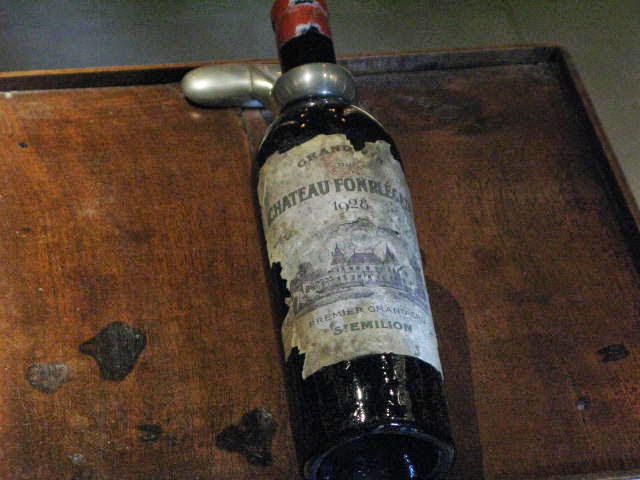
The library at Château Fonplégade displays their oldest bottle, a 1928.
Outside the château, on the sloping hillside of clay and limestone where the merlot is planted, is this ancient fountain, originally built by the Romans over a natural spring that continues to flow.


Mary is eagerly awaiting the best part of the visit, the tasting!


And here’s Amy, ready to oblige.

To my delight, Amy opened the 2004 Château Fonplégade for us to taste.  Generally, the most recent vintage is what is poured for tastings at domaines and châteaux.  Every once in a while, we’re fortunate to get to taste a mature wine.  This one is almost 10 years old!  Of the four wines we tasted, two from another château with the same owners, and a second label wine called Fleur de Fonplégade, the Château Fonplégade was the clear winner.  It is 95% Merlot and 5% Cabernet Franc with a wonderful perfume of red and dark fruit, a fleshy mouthfeel with flavors of berries, dark cherry, and plum along with savory herbs, but also enough tannic backbone and acidity for good balance.  This would be a wonderful wine to enjoy with a hearty dinner of grilled steak, roasted meats, or even a great weeknight meatloaf with mac & cheese.
It so happens that the American owners import their own wine to a warehouse in Napa, so it is possible to buy the wine in Saint Émilion and have it shipped at domestic rates from Napa.  We bought several bottles to enjoy back at home.

Mary cooked the saucisses et légumes we got earlier in the day at the Lussac market.  Along with a little cheese and fruit and a bottle of the rosé from Château Fonplégade, it was a simple and delicious end to a very nice day.  An interesting aspect was the American connection.  We Americans visited Annie and Laurent, the proprietors at Clos de la Barbanne who lived in the U.S. for several years, then spent the afternoon at Château Fonplégade, owned by Americans.

That’s our post for today.  We hope you enjoyed it.  Thanks so much for reading us.  Tomorrow will be our last day in France, so we still have more to share.  Keep checking back at Cépage et Cuisine as we wrap up our wine, food, and cultural vacation in Bordeaux.  In the meantime,

Cheers!


Mary♥Brian

Sunday, June 15, 2014

France Adventure – Wednesday, May 28, 2014 – Sauternes Day and Noble Rot

Bonjour les amis!  Hello, friends and welcome back to Cépage et Cuisine, Mary’s and Brian’s wine and food blog.  We’re continuing with our exploration of the Bordeaux region on our wine, cuisine, and cultural vacation in France.
I drove this morning to Montagne where there is an honest-to-goodness boulangerie.  On the way, there is this tiny chapel in a vineyard.  It’s a little bigger than a vineyard tool shed.  
I didn’t learn anything about its history, how long it has been there, whether it was part of a larger community.  It’s just out there in the middle of a vineyard.  
Perhaps there’s a relationship with this nearby château.  If we ever return here, I’d like to learn more about it.  In any event, it’s a beautiful image, ornate in its architecture, sitting among the vines, very peaceful.
Montagne is an ancient village, evidenced by the church’s Romanesque style, which is older than the Gothic style of Saint-Christophe-des-Bardes and even Saint Émilion.


The boulangerie prize of the day was a tartelette aux pommes, an apple tart.


Today is Sauternes day, about an hour’s drive to the southwest, across the Entre-Deux-Mers and on the other side of the Garonne River. 

Below again is the Bordeaux map, again with credit to Wine Spectator. 
We’re based just to the east of Saint Émilion.  You can see the Sauternes appellation and the village of Sauternes is in the far southwest part of the map.

As we made our way down through the rural stretches of the Entre-Deux-Mers, we were startled to see one of these critters dart out in front of us!  
Neither of us has ever seen a live wild boar before.  That guy came tearing out of a vineyard to our left, running in a flat-out, full gallop across the road, and disappeared into the bushes and trees on the other side.  That was one fast pig!

Our appointment at Château Rieussec was for 2:00 p.m. and we planned to have lunch in Sauternes.  Despite being so famous in the world of wine, Sauternes is a very small town.  


One of only a couple of places for lunch is Auberge les Vignes, which translates to inn of the vines.  


It’s just a little place across from the church, en face à l'église


It was a chilly, damp day and there was no room at the inn.

We were offered a table on the terrace under an umbrella, which we accepted.  We were partially successful in dodging the raindrops.


Here's the formule for the day.

We both selected a salad of melon jambon, cantaloupe and thinly sliced ham, similar to prosciutto.  You can see a carafe of the house white wine, which was a simple Bordeaux blanc, fresh and light and designed to pair with a simple meal.
Le plat was poulet fermier roti, roast chicken with fries and spinach.  It was just delicious, cooked perfectly, moist and flavorful.
Along with our fruit salad dessert and since we were having lunch in Sauternes the village, we wanted to have a glass of Sauternes the wine.
No surprise, the wine list included lots of choices of Sauternes.  We selected a glass of Château d’Arche 2010.  It was sweet, of course, but the sweetness was balanced by fresh acidity, not at all cloying.  It had those wonderful Sauternes aromas of citrus and tropical fruit notes and the palate was clean, smooth, and refreshing with spice, grapefruit, sort of a lemon candy quality, and a perfectly ripe white peach.

Amazingly and right here in a hometown café, Château d’Yquem 1975 was listed for a cool €1,560, about $2,175 per bottle.

Sauternes is a wine we drink pretty much on special occasions and usually when we’re hosting guests.  It is a dessert wine and can stand on its own as dessert or can be paired with fruit or cheeses, particularly strong cheeses like a Roquefort.  It is a wine that rewards aging.  The structure and balance of acidity, sweetness, and moderate alcohol levels allow it to age gracefully, perhaps more reliably than many wines.  

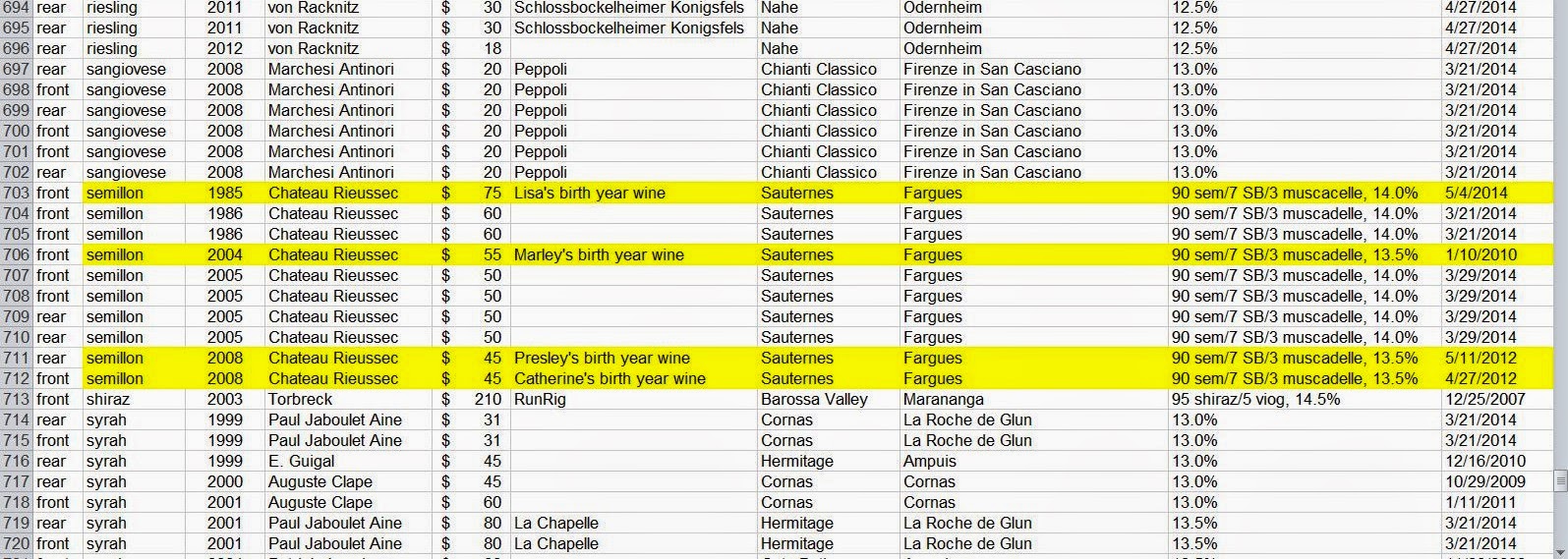
Below is a screenshot from our wine collection inventory.
Mary and I buy birth year wines for all the grandchildren with a plan to lay them down in our collection under temperature and humidity-controlled storage conditions, then celebrate with them sometime after they turn age 21.  I think Sauternes is a great choice for such a wine.  We even managed to procure one recently from Lisa’s birth year.

Château Rieussec is our favorite Sauternes producer.  It is reliably excellent, not too hard to find, and the price point is not out of reach for a special occasion wine.

Here’s a little background on Sauternes.  There are five communes in the appellation.  They are Sauternes, Fargues, Barsac, Preignac, and Bommes.  Like the Medoc producers, it is grouped in the 1855 classification into growths or crus.  There are three of these.  The top level is Premier Cru Supérieur, Superior First Growth.  There is one and only one producer in this category, which is Château d’Yquem.

The next category is Premier Crus Classé, First Growths.  There are 11 producers in this group, including Château Rieussec, as you can see in this label photo. The Deuxièmes Crus Classé, Second Growths, include 12 more producers.  All the others, numbering more than 250, can include Sauternes on their labels but cannot claim classified growth status.

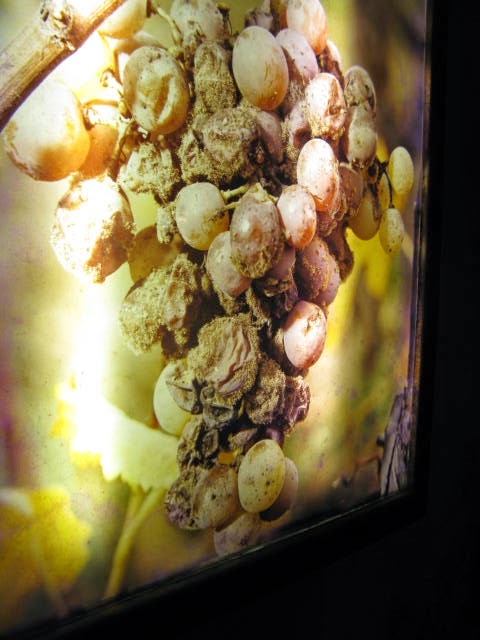
There is a small tributary of La Garonne in the Sauternes area called Le Ciron.  Mists form between the two rivers on autumn evenings that settle in the vineyards overnight.  A fungus called Botrytis cinerea, termed “noble rot” in the wine world, attacks the grapes, reducing their water content.  The sugar, acidity, and flavor compounds are concentrated into a rich nectar as a result.  The grapes are then picked, berry by berry in numerous passes through the vineyard, called tries (pronounced “trees”) as they reach the desired degree of dehydration.  This photo illustrates Botrytis-infected grapes.


Camille, our delightful guide, took us first to the vineyard on a chilly, drizzly afternoon.  
She showed us how the vines are pruned in winter for the desired number of new shoots during the growing season.  The property totals 93 hectares, about 230 acres.


Here, you can see what Camille calls the “babies.”

Just on the other side of the Château Rieussec vineyards is the adjoining property of Château d’Yquem.


Like many estates in Bordeaux, roses grow at the end of the vineyard rows.


Camille walked us through the technical production area.  Here is the destemmer.

These stainless steel fermentation vats are interesting as they are actually two vats, one on top of the other.


Here is the barrel aging room, where the wines are stored for 18-26 months.  This is the entire production of Château Rieussec for one year, about 72,000 bottles or 6,000 cases for the entire world market.  It is their best wine.  In poor vintages, they may not bottle it at all, such as in 2012.  They make a lesser wine, called a “second label”, which has higher production.

Sauternes is mostly comprised of Semillon, more than 90% in the case of Château Rieussec, along with a little Sauvignon Blanc and Muscadelle.  Here’s Camille, opening the 2011.

Look how pretty it is, golden and rich.  The first impression that comes to me is flowers, especially honeysuckle or gardenia.  There’s also a distinct grapefruit citrus and apricot quality.  The flavor profile is powerfully intense with both fresh and dried fruit flavors, peach, apricot, orange and grapefruit citrus, along with a little nutmeg or allspice.  I’ve often heard it described as similar in some ways to the flavor of crème brulée.  Overlaying it all is excellent balancing acidity and energy.  It was so delicious we just stood there for a while and sipped slowly.

Heading back to the gite we stopped to photograph this building in the town of Le Plan sur Garonne.  Nowadays it is the maire, the mayor’s office, and a community center.  
In a previous life, it was the school.  Carved over the windows on one is Ecole de Garçons, school for boys.  


On the other end is Ecole de Filles.  Mary says she thinks it’s a good idea.


A little farther along is Sauveterre de Guyenne, an old bastide town. 


The ancient gates to the town are remaining.

We picked up charcuterie, cheese, and fruit for a dinner snack back at the gite and enjoyed it with this Burgundy that was gifted to us by Marie and Yves as we left Magny-les-Villers.

That’s our post for today.  We hope you enjoyed it.  Thanks so much for reading us.  We have two more days in Bordeaux before heading home, so we have more to share.  Keep checking back at Cépage et Cuisine as we continue our wine, food, and cultural vacation in Bordeaux.  In the meantime,

Cheers!


Mary♥Brian