Sunday, November 16, 2014

November 16, 2014 - Recent Wine Notes and Pairings

Hi, everybody.  Welcome back to Cépage et Cuisine, Mary's and Brian's blog about wine, food, and culture. I often post brief wine notes at Twitter, which you can see if you follow us on Twitter at Cépage et Cuisine. I thought I would post a series of recent wine notes here on the blog, including a little more detail than the 140 character limit of Twitter, and some comments about food pairings. You may or may not be able to find the exact wines I describe, but the comments about the style and the pairings might be useful with similar wines and food pairing considerations.
German wine labels are famously hard to interpret. The producer is Domdechant Werner. Weingut means winery. Seit 1780 im familienbesitz means family owned since 1780. Hochheim is a village in the Rheingau region. Kirchenstück is a specific vineyard, which means that all the grapes for this wine come from that single vineyard. Riesling is the grape variety, of course. Spätlese is the ripeness level of the grapes on a scale that begins at Kabinett at the low end (our favorite), then Spätlese, then Auslese, then the sweet, dessert-style Rieslings. Trocken means the wine is fermented dry, that there is little or no residual sugar to add sweetness. The vintage is 2005, the year the grapes were harvested, so it has had nine years of aging when we opened it recently.

This is a delightful wine, clean, refreshing, great with food. It is aromatic of lime citrus, peach, and stony minerality.  The palate is briskly acidic for excellent tension, medium body, a dry style with very nice citrus, stone fruit, excellent minerality. It is beautifully balanced, moderately complex, with a medium length of finish. A spätlese trocken, it is only 12.0% alcohol, despite being pretty much bone dry.  We bought it at auction for $35. We paired it with a seasoned pork tenderloin, cooked outdoors on the grill on medium heat for about 20 minutes, with sides of baked apples, picked just days ago nearby in Michigan, sauerkraut, and pinto beans. The pairing is a good example of the versatility of Riesling. It does well with all the usual white wine pairings, but also pairs wonderfully with some meats such as this pork dish.
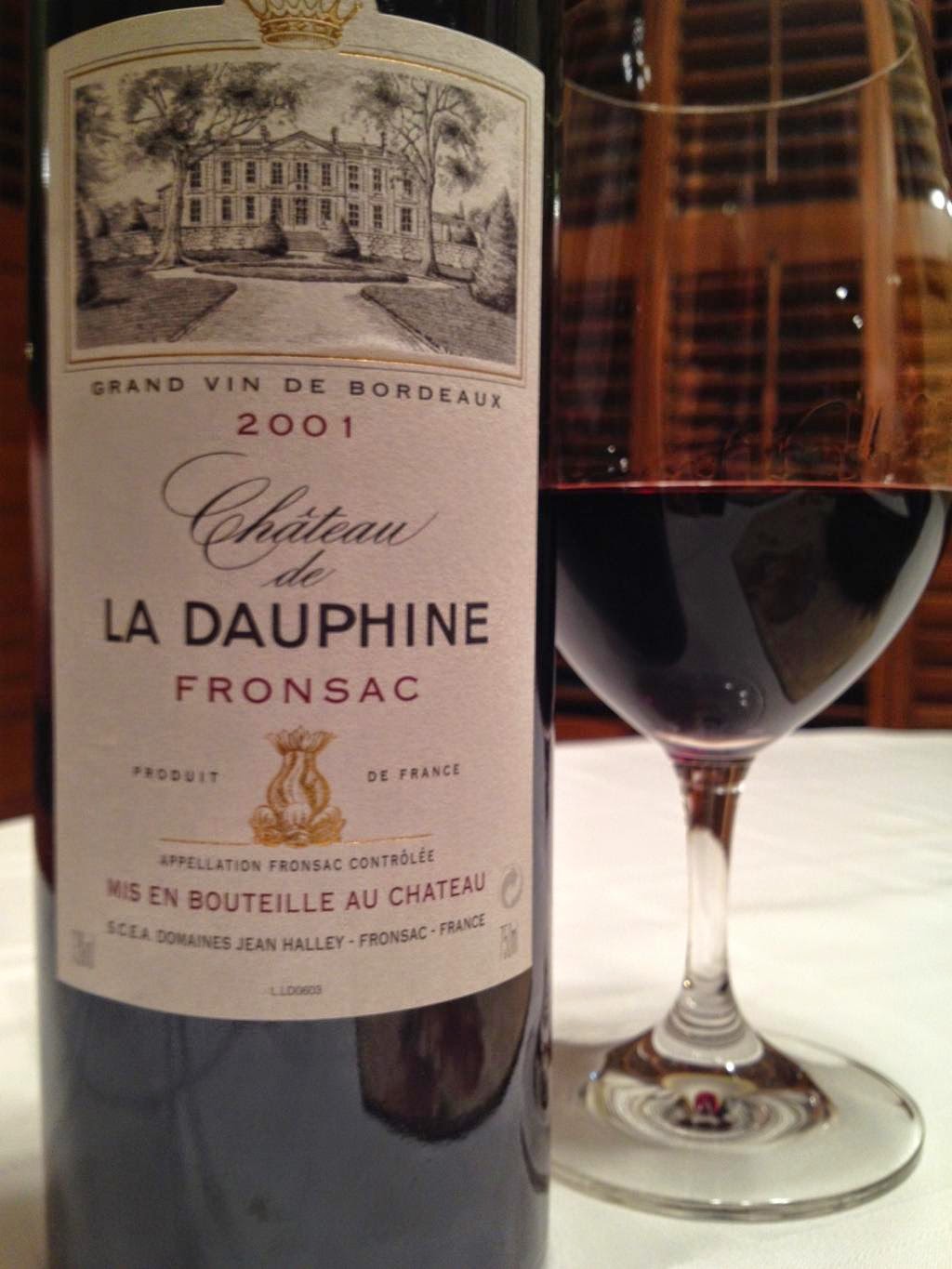
Chateau de La Dauphine is a right bank Bordeaux from the small town of Fronsac. Like most wines of Fronsac, it is mostly Merlot, 90% in this case. The remaining 10% of the blend is Cabernet Franc. This wine brings back happy memories for us because we visited La Dauphine back in May. Our visit is described in an earlier blog post.

Here's a photo of the chateau. Fronsac wines are not as prestigious as they were many years ago, which means they are a relative value when compared to Saint Émilion or other more famous areas. This was only $20 when we bought it several years ago. 

The clay and limestone soils of Fronsac are well suited to Merlot. The wines are rounder and fleshier than Cabernet-based blends. For many consumers, they are more approachable when young. This particular bottle is a 2001 vintage, which means it had 13 years of aging when we opened it a few weeks ago. I think it is just at its peak of enjoyment right about now, but probably won't get any better. I have one more bottle, so we'll find a nice occasion to open it pretty soon.

Here are my notes from the evening we opened it.  It's a beautiful, lovely, elegant wine with both power and finesse. It is aromatic of dark fruit, cedar, and herbs. The bottle had thrown quite a bit of sediment, but the wine was silky smooth, medium in body, with great freshness. Red and dark berries, cherry, and savory herbs comprised the flavor profile. It is beautifully balanced, moderately complex, and had good length. At 13.0% alcohol, we could enjoy a couple of glasses without feeling tired afterward. What a nice wine it is. 

Mary was in the mood for a nice steak, so even on a regular Wednesday evening, we grilled a couple of cuts of filet mignon to a nice medium with garlic mashed potatoes and a crunchy green salad. Here's a little tip. Merlot is especially well suited for pairing with lean cuts of meat. Although a Cabernet-based wine or Syrah would certainly not be a mistake, they are especially good with more marbled cuts like a ribeye.

I've had this bottle in our storage for several years. The producer is Viñedos y Bodegas Sierra Cantabria in the Rioja region of north-central Spain. The specific vineyard is Amancio and the vintage is 2004, so it has 10 years of aging. It is 100% Tempranillo, the signature grape of Rioja.

Spanish winemakers are trying to decide the best way to grow and vinify their grapes and to satisfy a global market, so they're in a bit of a state of flux at the moment. Some producers follow the traditional path and others, like this one, produce a bold, ripe style. For fans of the style, that's fine, but for us, very ripe, high alcohol wines don't have the distinctiveness and elegance of wines with better balance. To us, they lose the uniqueness of the grape variety and the place where they are grown. They taste like just another big red wine. At 14.5% alcohol, it's hard to finish the bottle between the two of us without feeling sluggish and tired. Plus, all the oak barrel influence and very heavy, modern bottle packaging makes it expensive. This wine cost $65, a lesson learned.

I wrote that it was aromatic and flavored of chocolate, oak, and ripe, black plum, not distinct, drinkable but glad to get it out of the inventory. It is an example of why we have very little Spanish red wine in our collection nowadays. I know there are wonderful wines still available from Spain and we're on the lookout for them, but shop carefully and buyer beware.

On the bright side, dinner that evening was a Cuban dish called picadillo, which was sensational! It is ground meat, seasoned with lots of garlic, herbs, cumin, peppers, onions, olives, and raisins, served with white rice and black beans. We must post a blog note about picadillo. Mary says it's easy and it is definitely delicious.
That's our post for today. We hope you enjoyed it. Thanks for reading us at Cépage et Cuisine. Don't forget you can also follow our nightly wine Tweets (well, most nights) on Twitter by the same name. In the meantime,

Cheers!

Brian♥Mary

Sunday, August 3, 2014

Mary’s Cream of Asparagus Soup – August 3, 2014

Hello, everybody.  Welcome to Cépage et Cuisine, Mary’s and Brian’s blog about wine, food, culture, and people.   Here’s a post in a series of occasional articles about simple French-inspired dishes and delicious wine pairings.  Today’s post is cream of asparagus soup, what the French call velouté d'asperges because it’s so velvety.  
Asparagus comes into season where we live in Michigan in late spring and continues through the summer, so it is fresh and abundant.  It was in season while we were in France recently, so it was a common first course dish.  Mary’s going to be the primary author of today’s post to talk through the ingredients and preparation.  I’ll be back with the wine at the end. 

On our last couple of trips to France, Brian has raved about fresh asparagus soup.  Brian is a soup guy, while I usually order salad. This year, I decided I would try asparagus soup if it presented itself.  
It was the special seasonal entrée (first course) the night we went to the Auberge Saint Martin in Bouilland, a small village near Beaune.  
We both ordered it and it was fabulous, so delicious and pretty!  When we returned home, I made an attempt at it as a first course.  It turned out to be delicious, probably not quite as wonderful as in Bouilland, but pretty good for my first try.
First, we made a trip to our weekly farmer’s market here in Plymouth to find the best and freshest ingredients possible.
The ingredients are fresh asparagus, chopped white onion, chicken stock (I make my own … maybe a post on that later), butter, whole wheat flour, salt and pepper, whole milk, crème fraiche, and fresh-squeezed lemon juice.  You can use sour cream instead of crème fraiche, but Brian makes his own crème fraiche from scratch and it is so, so much better than store bought sour cream.


I started by chopping the asparagus in lengths of about an inch or so, both tips and stalk.

The asparagus, onion, and some of the chicken stock went into a saucepan and simmered until the asparagus is nice and tender.
Brian was perched on a kitchen barstool while I cooked and snapped a couple of photos of the kitchen counter.  Here’s where we throw wine bottle corks until we figure out how to recycle them.  We’re still working on that.  Brian’s brother, Phil, made a cork trivet for us, but we have way too many corks to do much of that.  I wish we could recycle them somehow.
This picture of the glass of white wine?  That is often the most important ingredient … cooking wine (wine for the cook!).


The cooked asparagus, onion, and chicken stock go into the blender to puree.
I use the same saucepan to melt butter and stir in the flour and seasonings.


After that is blended well, I whisk in more chicken stock.
When the mixture starts to boil, I stir in the pureed asparagus and milk.

I put the crème fraiche in a small bowl by itself, or just a one cup measuring cup like this, and ladled in a little of the hot soup to get the crème fraiche to a pouring consistency.

The cream mixture is added back to the soup along with the lemon juice to freshen it up and add a little acidity.  At this point, it’s just stirred and allowed to come up to serving temperature.
Garnish with a couple of steamed asparagus tips and a little crème fraiche and get ready to enjoy.  Wait!  Brian has to talk about the wine first!  I don’t know how he chose this particular wine to serve with cream of asparagus soup, but it is a match made in heaven!
Brian here.  I chose this wine because it is light-bodied, very fresh tasting to go with the flavors and textures of summertime cooking with fresh ingredients, and has refreshing citrus and mineral qualities. 

Muscadet Sévre et Maine is an appellation in the Loire Valley of France, in the western part almost to the Atlantic Ocean.  The grape is Melon de Bourgogne and the producer is Domaine Bonnet-Huteau.  The “sur lie” that you see on the label means the wine was aged on the dead yeast cells before bottling, which gives it a fuller, creamier quality.  Drinking this wine makes you almost feel the sea spray.  It has a clean, almost saline quality to go along with a lemony citrus aroma and flavor.  At only 12.0% alcohol, it won’t leave you feeling dragged down or lethargic after sharing a bottle with someone you love.  And the best part?  It’s only $13.


A few fresh berries and a dollop of crème fraiche would not be a mistake.
There’s Sonoma in the background, supervising the production and hoping for a little leftover crème fraiche.

That’s our post for today.  We hope you found it interesting and appetizing.  We’re already planning our next blog post, so keep checking back for more wine, food, and cultural adventures at Cépage et Cuisine.  In the meantime,

Cheers!

Mary♥Brian

Friday, July 4, 2014

Independence Day – July 4, 2014

Happy Independence Day, everybody!  Welcome to Cépage et Cuisine, Mary’s and Brian’s blog about wine, food, and culture.  And for our readers in France, here’s a serving of American culture for you.  July 4 is a holiday when Americans celebrate our independence.  It usually includes parades, picnics with traditional foods, and families getting together to have fun.

Mary and I began our day by attending the July 4 parade where we live in Plymouth, Michigan.   It’s a classic small town American event on Main Street, a combination of patriotic and quirky.

Here is a series of photos and short videos from the parade.


Plymouth residents waiting for the festivities to begin.
Lots of kids on bikes to literally get things rolling.  
Click on the videos to enjoy.


Here’s Uncle Sam.


And behind Sam is the Plymouth Fife and Drum Corps.
Unicycling club.


Paws is the mascot of the Detroit Tigers.


Bagpipe band.

Rosie the Riveter was honored since the famous Willow Run bomber plant was nearby.  Willow Run produced many of the B24 Liberator heavy bombers during World War II.  
Here are a couple of Rosies who actually worked at Willow Run.  Once again for the benefit of our French readers, Rosie the Riveter is a term used to describe women who worked in munitions factories during World War II while many men served in the military.

Our favorite part of the parade was the Boingy People.  Yes, that's what they're actually called.  This definitely falls into the quirky category. 
Steve King and the Dittilies performed vintage rock-n-roll.
Every Independence Day parade has a beauty queen …
… and a marching band.
Our own picnic lunch was on our deck at home.
Beautiful weather, nice temperatures, blooming flowers.  


Quite a contrast with this image taken from the same spot back in February.


Lunch was a delicious collection of cheese, charcuterie, melon, and a refreshing rosé.  
It wasn’t exactly all American.  The prosciutto di Parma and soppressata are Italian and the Comté and Doux de Montagne are French.
The wine was La Vieille Ferme Ventoux rosé 2013, a refreshing blend of Cinsault, Grenache, and Syrah from the Southern Rhone Valley of France, aromatic of roses, berries, and melon.  In the mouth it is brisk and racy with light flavors of orange and grapefruit citrus, raspberries, strawberries and melon.  It’s beautifully balanced, surprisingly complex, with a medium finish.  At $8 it’s a terrific value and widely available.
What’s July 4 without something grilled?
Grilled burgers, red onions, Roquefort or Jack, and the fixings, Mary’s homemade potato salad, and a Napa Valley Syrah was the ticket.


The wine was a Lagier Meredith Syrah Napa Valley Mt. Veeder 2005.  


Our back yard on July 4, 2014.


Steve Lagier and Carole Meredith grow Syrah at their mountaintop estate on Mt. Veeder.  Relatively cool growing conditions produce a wine that has the boldness of a New World Syrah, but still some of the savory and peppery notes of the Old World.  
This wine has exuberant blackberry and blueberry characteristics with a spiciness to keep things more interesting than just another fruity California red wine.

That’s our post for today, a heaping helping of American culture along with a little help from our culinary friends in France and Italy.  We hope you enjoyed it.  Keep checking back for more wine, food, and cultural adventures at Cépage et Cuisine.  In the meantime,

Cheers!

Mary♥Brian